
Silicone undercuts in silicone molding are not necessarily a concern, but they should be considered in light of material plasticity, part geometry as well as demolding technique to reveal latent production hazards.
Any part geometry feature that does not allow straight-pull ejection out of the mold cavity is called an undercut – it can be a protrusion, a recess, or an overhang that does not conform to the primary direction of the mold opening. Undercuts in any rigid plastic, such as ABS or PP, are nearly always required to have side action, collapsible cores, or inserts since the material is non-recovering.
Silicone is not identical as it is very elastic and elongated (typically 3001000 percent, depending on grade). This permits some flexibility in the demolding process – most parts can be stretched or flexed as they are ejected without any permanent harm. Undercuts of small size (isolated at less than about 12 mm depth) and shallow (with radii of generous size) can be frequently stripped away without mechanical aid unless in hard grades.
But there is a limit to this leeway. Undercuts that are deep, sharp or high-ratio of aspect still may tear, be deformed or create flash or undue force on the demolding that is destructive to the part or the mold with time. Now, undercuts are considered okay to many designers who bring the same assumption with them as thermoplastics: silicone is flexible. Practically, the necessity of undercut feasibility is very dependent on Shore hardness, wall thickness, draft angles and the mode of operation (manual or automated).
Undercuts in silicone casting can only be successfully done to controlled depths, beyond which they become tearing, deforming, and complexity of tooling.

What Is an Undercut in Silicone Parts?
Any geometry of silicone parts that interferes with direct ejection off the mold is an undercut in silicone parts which forms a locking feature that the component of the part/mold must deform or slide off to be demolded.
There are undercuts, which are either internal (recesses or cavities within the part) or external (protrusions or lips within the exterior). They may have functional purposes (e.g. snap fits, sealing lips, gripping features) or decorative purposes (e.g. drops carved in the logos, textures).
The following is a concise summary of some of the techniques of undercutting silicone molding:
| Undercut Type | Example | Risk Level |
| External snap lip | Flexible edge or barb | Low–Medium |
| Internal groove | O-ring channel or slot | Medium |
| Reverse hook | Locking tab or undercut barb | High |
| Decorative recess | Shallow logo or pattern | Low |
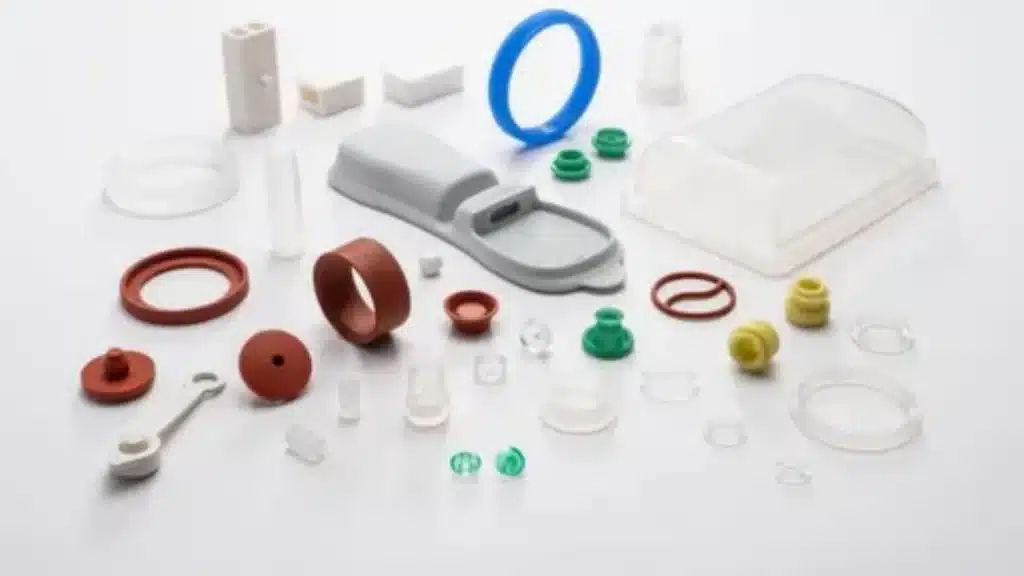
Even non-formal, such as underlip motions, are usually more tolerant in silicone than in a hard material, but the risk increases with depth, sharpness, and absence of draft.
Why Silicone Allows Limited Undercuts
It is the fact that silicone has a strong elastic recovery, which is unlike rigid plastics in their ability to cope with undercuts the substance is able to stretch a long way during demolding and realign itself without becoming pliable.
The amount of give the part has is determined by a number of factors:
- Elastic recovery Liquid silicone rubber (LSR) and high-consistency rubber (HCR) types of rubber generally provide 300-800 per cent elongation that enables the component to bend around any hindrance.
- Shore hardness is a critical factor — see our Shore hardness guide for silicone — softer materials are simpler to deform, however, tearing may result when too much work is applied.
- Demolding technique This technique, manual stripping, has better tolerance than automated ejection, in which higher consistency of force may lead to defects.
The main factors affecting the feasibility of undercut are:
| Factor | Effect on Undercut Feasibility |
| Shore hardness | Softer = more flexible (e.g., 20–40A better) |
| Wall thickness | Thicker walls resist deformation and tearing |
| Part depth | Deep cavities increase risk during stripping |
| Draft angle | Proper draft angle for silicone parts reduces stress concentration and eases release |

To withstand even slight undercuts, a proper draft angle for silicone parts is required; otherwise, this force may focus and result in tears, notably when manufacturing a batch.
When Undercuts Are Acceptable
Undercuts in silicone molding are tolerated when geometry is not too demanding of the stress and elastic limits of the material and the demolding forces are not too high as these may cause defects.
Common safe cases are of shallow outer lips in soft grades whereby the section may become sewn off with hand force. Silicone with lower hardness ( Shore A 20 40) is more tolerant to deformation, and manual processes provide operators with the opportunity to flex and angle the part.
The effects of production are insignificant in such cases – cycle times are not excessive, scrap rates are low and tooling wear is being kept in check.
| Condition | Acceptable? | Notes |
| Shallow (<1mm) | Yes | Low risk, often stripable manually |
| Soft silicone (Shore A 20–30) | Yes | More forgiving, higher elongation |
| Thick rigid geometry | No | Higher tear risk even with flexibility |
| Automated demolding | Risky | Less flexibility; consistent force needed |
Also in our case, most custom silicone mats or phone cases featuring slight lips lips to hold on to can easily fit into this acceptable price range provided that they are designed well.
When Undercuts Become Risky
Undercuts become dangerous when they surpass the safe amount of deformation limit causing the straining excessive stretch resulting in tearing or distortion of the mold.
Problems are dramatically raised by deep cavities (>3 5 mm depending on hardness), sharp reverse hooks, high Shore hardness (>=60A), or thin walls (<1 mm). Dagrammatic stress concentrations because of developing poor draft, and defects and stressed parts can increase thousands of transitions with automated ejection.
Some of the usual effects are:
| Risk Factor | Consequence |
| Deep cavity | Tearing during demold |
| High hardness (≥60A) | Reduced flexibility, higher force needed |
| Sharp corner | Stress concentration, crack initiation |
| Poor draft | Demolding damage, flash, part distortion |
These problems add up in large quantities of runs to inconsistent production when high volumes frequent tear and high-force ejection recidivism abrades the surface of the moulds or pushes them out of the run.
Tooling Solutions for Undercuts
Undercuts that exceed the bounds of flexibilities during demolding require compensation of tooling – but every solution is more costly and cumbersome.
The choices go as far as mechanical side measures and total redesign. Before mold steel is cut it is critical to weigh these trade-offs by taking into consideration early DFM review with our in-house mold manufacturing team.
| Tooling Solution | Cost Impact | Complexity | When Used |
| Side slide | High | Medium | External undercut |
| Collapsible core | Very high | High | Internal hook or deep feature |
| Split mold design | Medium | Moderate | Medium depth, multi-cavity |
| Design modification | Low | Low | Early stage, avoid complexity |
External features are often used as side actions, and internal undercuts collapsible corres cause costs to skyrocket (occasionally by 3050 percent of the price of straight-pull tooling). When a major redesign is needed, a small one (adding draft, softening a hook) is quite often worth saving more than it costs.
Undercuts in Compression vs LSR Injection
Undercuts are different when it comes to compression molding (HCR/solid silicone) and LSR injection – direct influence on risk tolerance.
Most silicone compression molding process options can be more operator controlled, whereas undercuts with LSR are more challenging as it is more automated and sets stricter tolerances.
| Factor | Compression | LSR Injection |
| Manual demolding | More forgiving | Less forgiving |
| Automation | Low | High |
| Tear risk | Moderate | Higher if automated |
| Tooling slide feasibility | Moderate | Complex |
Peeling can be done gradually in compression and without concern in LSR injection molding, because high-speed ejection requires meticulous geometry.
Common Mistakes in Designing Undercuts for Silicone
These are the pitfalls of which we hear every day:
- Neglecting Shore hardness – in which a 70 A part is assumed to act as a 30 A part.
- Creation of sharp internal non-radiating, non-drafting hooks.
- Bypassed DFM inspection – direct out-of-tool file transfer.
- Geometry (it does not fix tearing) is assumed by assuming the manual trimming.
- Backorder costing (tooling cost understated)– introducing slides into the dark.
All these cause delays, rework or unstable production.
Conclusion — Undercuts Require Controlled Engineering Judgment
The softness of silicone gives it some freedom to undercut the mold so that rigid plastics cannot or will very costly undercut, but geometry, Shore hardness, wall thickness, and process type will eventually decide whether it can be undercut.
The price of tooling rapidly goes up when mechanical characteristics such as slides, collapsible cores are involved. Fast and comprehensive DFM inspection — investigation of hardness, draft, radii, and demolding direction — eliminates high costs of redesign and makes production steady. Our OEM & ODM silicone manufacturing team can help you achieve this from the very first prototype.Undercutting with realism: test little, measure forces, and prefer simplicity where it can be had. This is the way high quality and reliable silicone parts are forged reliably.