

Uncategorized
Silicone vs Rubber: Differences, Pros/Cons, and Best Applications
Silicone and rubber are often used interchangeably, but their performance differs significantly. This guide compares silicone vs rubber in terms of heat resistance, chemical stability, flexibility, durability, and best applications. Learn how to choose the right material for consumer, automotive, medical, and industrial products.
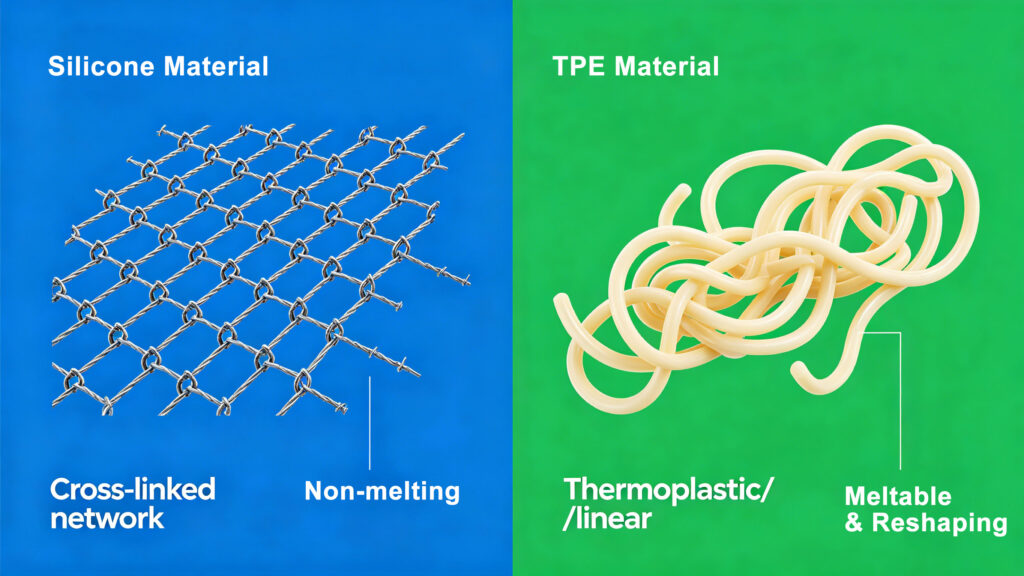
Silicone vs TPE: Which Is Better for Consumer Products?
Silicone and TPE are widely used in consumer products, but their performance differs in durability, safety compliance, aging resistance, and long-term stability. This guide compares silicone vs TPE to help brands and engineers choose the right material for baby products, electronics accessories, kitchenware, and more.
Uncategorized
Silicone vs EPDM for Seals: Temperature, Weathering, Chemical Resistance
Silicone and EPDM are widely used for seals and gaskets, but their performance differs significantly under heat, UV exposure, and chemical contact. This guide compares silicone vs EPDM in terms of temperature range, weather resistance, compression set, and chemical compatibility to help engineers select the right material for long-term sealing reliability.
Uncategorized
Silicone vs NBR for Oil Resistance: When to Choose Which
Silicone and NBR are commonly used for seals and gaskets, but their performance differs significantly in oil-rich environments. This guide compares silicone vs NBR in terms of petroleum resistance, temperature tolerance, compression set, and long-term sealing reliability to help engineers choose the right material for automotive and industrial applications.
Uncategorized
Silicone vs Viton (FKM): Heat & Chemical Resistance Comparison
Silicone and Viton (FKM) are both used in high-performance sealing applications, but their resistance to heat and aggressive chemicals differs significantly. This guide compares silicone vs Viton in terms of temperature limits, chemical stability, compression set, and long-term durability to help engineers select the right elastomer for demanding industrial environments.
Uncategorized
Food-Grade Silicone Explained: What It Is and What It’s Not
Food-grade silicone is widely used in kitchenware and baby products, but many brands misunderstand what the term actually means. This guide explains FDA and LFGB standards, platinum vs peroxide curing, safety testing requirements, and common myths about food-grade silicone to help product developers make informed material decisions.
Uncategorized
Platinum-Cured vs Peroxide-Cured Silicone: Differences & Use Cases
Platinum-cured and peroxide-cured silicone differ in crosslinking chemistry, affecting purity, odor, compliance, and long-term performance. This guide explains the technical differences, mechanical properties, food-grade implications, and ideal use cases to help product developers choose the right curing process for their application.
Uncategorized
Shore Hardness Guide for Silicone (Shore A): How to Choose
Shore A hardness determines how soft or firm silicone feels and performs. This guide explains what Shore hardness means, how it affects sealing, compression set, and durability, and how to select the correct silicone durometer for gaskets, phone cases, kitchenware, and industrial applications.
Uncategorized
Silicone Color Matching: What Affects Color Consistency in Mass Production
Silicone color consistency in mass production depends on more than a Pantone reference. This guide explains how pigment dispersion, base material variation, curing temperature, and quality control affect silicone color matching, and how manufacturers reduce batch-to-batch variation to maintain brand consistency.