
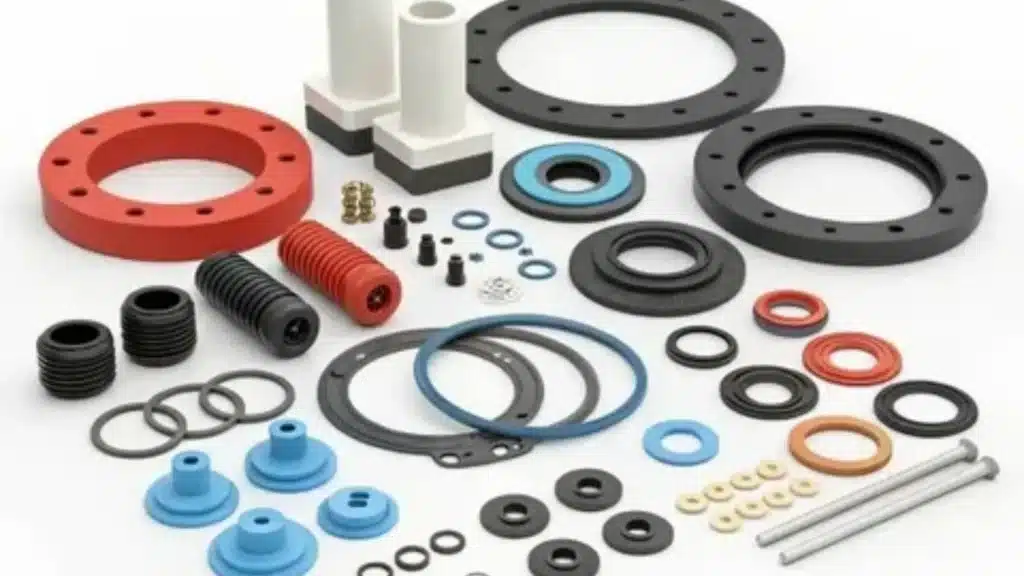
Engineered components Custom silicone gaskets and seals are designed to stop leakage, isolation, tolerances, and enable long-term reliability. Effective sealing is affected by material and geometry matching, compression behavior and operating conditions. Most purchasers believe that seals are mere commodity items, but failures in sealing are usually caused by neglected engineering factors and not the material.
Properly engineered custom silicone gaskets and seals work when the material properties, seal geometry, tolerances and operation conditions are designed as a unified system.
What Are Custom Silicone Gaskets and Seals?
Custom silicone gaskets and seals are highly engineered elastomeric products designed to form a dependable barrier to fluids, gases, dust and contaminants and allow mechanical movement and thermal expansion.
Definitions and Key Distinctions
A gasket is commonly used to seal two stationary parts together, at the surface, like flanges or halves of an enclosure. A seal more generally separates environments or fluids, in applications that are dynamic or semi-dynamic.
O-rings are a special circular shape of a seal which is based on compression within a groove. By contrast, custom profile seals have complicated cross-sections that are customized to fit unusual assembly geometries.
| Component Type | Primary Function | Typical Use |
| Silicone Gasket | Surface sealing between components | Enclosures, flanges |
| Silicone Seal | Environmental or fluid isolation | Equipment interfaces |
| O-Ring | Circular compression seal | Valves, fittings |
| Custom Profile Seal | Specialized sealing geometry | Complex assemblies |

How Silicone Sealing Works
Silicone gaskets and seals operate based on controlled compression. The material when installed deform to fill microscopic irregularities on the surface to form a continuous barrier. It has a high elasticity and can be used to close after repeated compression cycles, retaining its sealing force over time.
Such flexibility and resilience make silicone a specific choice when it comes to applications of vibration, temperature cycling, or irregular mating surfaces.
Why Silicone Is Widely Used for Gaskets and Seals
Silicone is a special elastomer due to its ability to provide consistent performances in extreme conditions compared to most elastomers that cannot perform.
The elastic recovery of its molecular structure is of good quality as it is possible to keep the seals in contact even after years of service. Silicone can also be used in continuous temperatures between -60 C and 230 C (and even higher in specialty formulations) without showing any substantial degradation. It is much more resistant to weathering, ozone and UV radiation than natural rubber and most synthetics.
Material Property Comparison
| Material Property | Why It Matters for Sealing | Silicone Advantage |
| Compression Set Resistance | Seal longevity | High |
| Temperature Stability | Performance extremes | Strong |
| Chemical Resistance | Fluid compatibility | Reliable |
| Flexibility | Surface conformity | Excellent |
| Aging Resistance | Long-term durability | Strong |
Such characteristics justify why silicone is often specified by the engineers in silicone sealing parts in harsh conditions.
Common Types of Custom Silicone Gaskets and Seals
Optimal custom silicone gaskets and seals are designed to fit and perform to the particular mechanical and environmental needs of the assembly.
| Seal Type | Typical Application | Key Benefit |
| Flat Gasket | Surface sealing | Simplicity |
| O-Ring | Fluid sealing | Compression efficiency |
| Extruded Seal | Continuous perimeter sealing | Design flexibility |
| Lip Seal | Dynamic sealing | Motion control |
| Custom Molded Seal | Complex interfaces | Precision fit |
Simple bolted joints are good with flat gaskets. Custom molded silicone seals are excellent in applications where complex geometry is needed or multi-functional integration is required.
How to Choose the Right Silicone Material for Sealing Applications
One of the most important decisions when designing silicone gasket is material selection. The correct compound will balance the mechanical needs with the environmental and regulatory needs.
Key Selection Factors
| Selection Factor | Consideration | Impact on Seal Performance |
| Hardness | Compression force (Shore A 20–80) | Seal effectiveness |
| Compression Set | Recovery after prolonged load | Long-term sealing |
| Temperature Exposure | Operating environment | Material stability |
| Chemical Compatibility | Media in contact | Longevity |
| Regulatory Needs | FDA, UL, RoHS, etc. | Application suitability |
Platinum-cured medical-grade silicone may be necessary (food-contact or medical). Industrial applications such as high temperature can require peroxide-cured or fluorosilicone resins to increase chemical resistance.
Seal Design Factors That Affect Performance
Failure of seals is usually attributed to design flaws and not due to material flaws. The correct design of silicone gaskets takes into account the whole sealing system.
Critical Design Elements
- Compression Ratio: Generally 1535% with static seals; above this could be over-compressed and fail prematurely.
- Groove Design: It should permit the expansion of the materials and should be sufficient to fill it without over squeeze.
- Tolerances: Silicone components can be molded with precision of ±0.1 mm, although designers need to take into consideration the contraction and thermal expansion.
- Surface Mating Conditions: Roughness, flatness and parallelism have a direct impact on leak paths.
- Geometry Optimization: The use of beads, ribs, or dual-seal profiles can significantly enhance performance at different pressures.
When it is important to have performance, the design should always be checked by using finite element analysis (FEA) and by physical prototyping.
Manufacturing Methods for Silicone Gaskets and Seals
Various production processes are appropriate with different geometries and volumes. Knowledge of these practices assists sourcing teams to make good decisions regarding tooling investment and lead times.
| Process | Best For | Advantage |
| Compression Molding | Precision molded seals | Accuracy and material efficiency |
| Extrusion | Continuous profiles | Efficiency and length flexibility |
| Co-Injection / Overmolding | Complex integrated parts | Functional integration |
| Secondary Finishing | Tight tolerance needs | Precision refinement |
Most custom molded silicone seals are still done by compression molding, as this technique provides good dimensional control, and allows complex geometries. In high volume continuous seals, extrusion then splicing or corner molding offers cost effective solutions.
In the case of custom silicone components, the cost and risk can be d
Common Failure Modes and How to Avoid Them
Learning about the reasons and methods by which silicone seals fail assists engineers in designing more dependable systems in the early stages.
| Failure Mode | Common Cause | Prevention Strategy |
| Leakage | Poor compression design | Correct seal geometry and ratio |
| Compression Set | Wrong material choice | Material optimization and testing |
| Cracking | Environmental mismatch | Correct formulation selection |
| Premature Wear | Dynamic misuse | Proper seal type and lubrication |
The most sure method of identifying potential problems before they get to production is regular testing in the actual operating conditions.
Industry Applications for Silicone Gaskets and Seals
The demands of industrial silicone seals differ greatly depending on industries.
| Industry | Typical Silicone Seal Application | Key Requirements |
| Automotive | Engine, HVAC, and lighting seals | Heat, oil, and vibration resistance |
| Electronics | Waterproof and dustproof enclosures | IP67/IP68 performance |
| Medical Devices | Fluid paths and sterile barriers | Biocompatibility and sterilization |
| Industrial Equipment | Pump, valve, and machinery sealing | Chemical and pressure resistance |
| Consumer Products | Kitchen appliances and wearables | Safety compliance and aesthetics |

Carmaker applications tend to require wide temperature operation and fluid resistance. The extractables and biocompatibility are of medical use. Electronics are concerned with stable compression across broad ranges of temperature variations.
Common Mistakes When Specifying Custom Silicone Seals
The following are common errors in specifications that are committed by experienced engineers:
- Making seals a normal commodity component rather than an engineered component.
- Selection of material based on the initial cost/availability.
- Ruling out long-term compression-set performance data.
- Not taking the effect of tolerances and groove design seriously.
- Assessing the prototype samples without accelerated life test.
- Not taking into account assembly procedures and possible damage during installation.
To avoid these traps, it is necessary to consider the gasket or seal as an important part of the system, not a simple molded rubber item.
Conclusion — Sealing Performance Depends on Engineering, Not Just Material
Proper custom silicone gaskets and seals are not molded assemblies, but designed systems. How the material, geometry, tolerances, and manufacturing processes interact determines the reliability that is achievable through sealing.
Product teams can take on the responsibility of leakage prevention, extended service life, and overall system reliability by treating custom silicone gaskets and seals as an engineering choice than as a procurement component. The most effective sealing solutions are a result of intensive cooperation between the design engineers and the well-established manufacturers who not only have the knowledge of the material science, but also know the real-life needs of the usage.