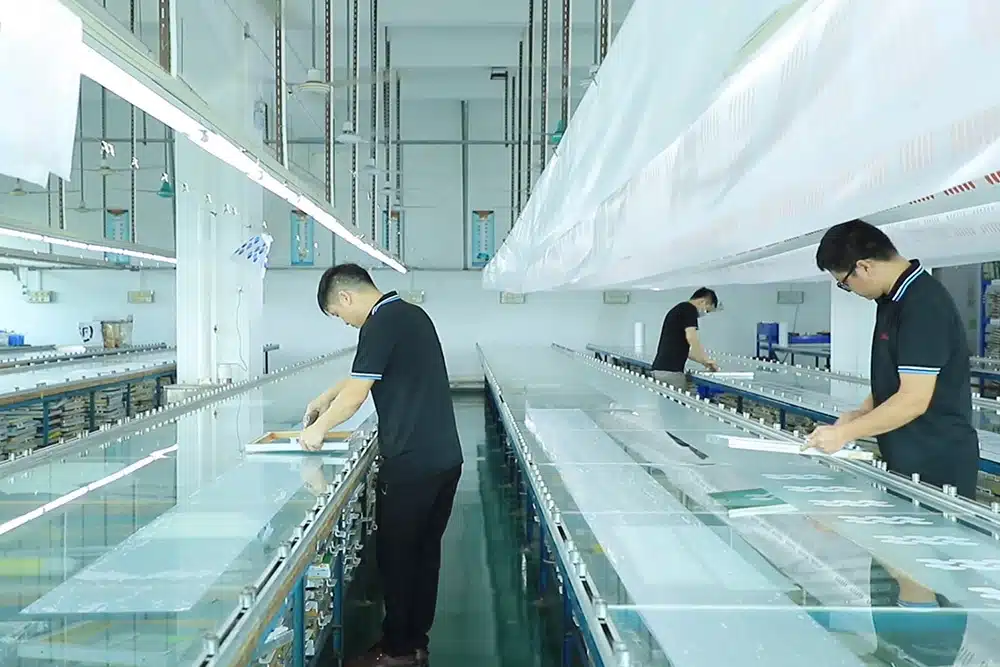

The correct tolerances for printed graphics on silicone parts could mean the difference between a smooth production and continuous quality disputes. Unlike rigid sheets such as plastic or paper, silicone screen printing tolerances have to consider the stretch and compression properties of the soft, flexible silicone, as well as some movement that occurs during the printing process.
In our factory, we have seen hundreds of product engineers who assume that we get them to be aligned to the tee from the CAD drawings. In reality, good process control will produce consistent results within a defined range. Ahead of time, knowing these practical ranges can help you establish specifications that can be met by manufacturing, minimizing rejects and accelerating approval cycles.
What “Tolerance” and “Registration” Mean in Silicone Screen Printing
Tolerance is just the range of variation that is acceptable for a feature of the print. Position tolerance is the amount of deviation a logo/ graphic will undergo from where it was placed. The concept of size tolerance is intended to account for variation in printed elements, both for expansion and shrinkage. Registration refers to the degree of match between a number of colors.
These are not bad marks, but simply the realistic limits of an effective process. The substrate may be compressed under a squeegee, be slightly extensible when being handled or have different thicknesses in different parts on silicone. This is more difficult to achieve than with flat level substrates.
How Silicone Substrate and Geometry Influence Tolerances
For softer durometers (lower shore A) slightly looser tolerances are required as they deform more during printing. The variation is also increased with curved surfaces, change in wall thickness or small parts with few locating features. Small changes in material batch or environmental factors can be a factor.
This is why teams with experience talk with their supplier about geometry and fixturing prior to finalizing artwork. Most alignment headaches are avoided by the right conversation at the DFM stage.
Position Tolerances for Logos and Graphics on Silicone Parts
Position tolerance is usually specified by stating the acceptable amount of deviation from a reference edge, centerline or functional datum, and is expressed as ±X mm. Typically, we’re able to deliver flat or gently contoured silicone parts to within ±0.5 mm with most production runs that incorporate well fixtured parts. If the geometry is more complex 3D or soft material, then it is more realistic to get ±0.8 to 1.2 mm.
If your product roadmap depends on repeatable silicone screen printing for custom parts, you need a partner that can discuss tolerances at the DFM stage instead of guessing during mass production.
DFM Rules for Setting Position Tolerances
- It is a good practice to use a set of position tolerances as detailed in DFM Rules.
- Use available reference points which are consistent with the way the part will be positioned in the printing fixture.
- Don’t set an extremely close absolute position for long, thin graphics that follow curves.
- Identify and specify critical vs cosmetic dimensions on drawings.
Size Tolerances for Printed Features
Variations in printed features may occur depending on the viscosity of the inks, screen mesh, squeegee pressure, and ink adhesion to the silicone surface. Thin lines can get a bit wider and small gaps can close up. The effects are more prominent on softer silicone.
Minimum Line Thickness and Gap Size for Silicone Prints
For clean, consistent production printing we recommend:
- Min line width 0.25-0.3mm (thinner line is possible to break or to fill).
- The smallest gap between the elements: 0.3–0.4 mm
Lower print sizes (less than 150 x 150mm) may need special mesh and ink adjustments, and may produce slight variations between prints. Simplifying where possible is a good way to get better results for designers.
How to Specify Size Tolerances on Drawings
Avoid getting bogged down in every detail of the logo, but ensure that all the dimensions that will impact the brand are accounted for. Making it practical and keeping the most important items safe by grouping non-critical elements together under a general note.
Color-to-Color Registration Limits in Multi-Color Silicone Screen Printing
Registration tolerance is a measure of the accuracy of the color registration. If your registration slips, you’ll notice halos, shadows or misaligned spaces between colors.
Realistic Registration Capability on Silicone Parts
For flat or simple parts, with good fixturing, color-to-color registration accuracy is typically maintained at ±0.3–0.5 mm. For curved surfaces or extremely soft materials, ±0.6–0.8 mm is the more reasonable figure. These ranges are based on years of production on thousands of custom silicone products.
Design Techniques to Make Registration More Forgiving
Smart editing of artwork diminishes the effect of slight changes:
- Add some overlap (trapping) between adjacent colors
- Add thin keylines or outlines as necessary
- Do not butt join high contrasting colors on critical areas.
- When creating a multi-color logo, try to make it as simple as possible.
The following methods are employed to keep the product looking premium even with the slightest changes.
Recommended Tolerance Ranges Table for Common Scenarios
| Scenario | Position Tolerance | Color Registration | Notes / Conditions |
| Small logo on flat area | ±0.4–0.6 mm | ±0.3–0.5 mm | Good fixture, standard hardness |
| Logo on gently curved surface | ±0.6–0.9 mm | ±0.5–0.7 mm | Proper part locating required |
| Multi-color print on soft grip | ±0.8–1.2 mm | ±0.6–0.9 mm | Softer durometer, more variation |
| Large graphic near edge | ±0.7–1.0 mm | ±0.5–0.8 mm | Edge effects and material flow matter |
These are common beginning points used based on our production experience. Actual capability will vary according to part design, material hardness and process controls. Be sure to check with your manufacturer based on your actual geometry.
How to Validate and Agree Tolerances with Your Supplier
It is recommended to start sharing 3D CAD and final artwork as early as possible. Discuss the tolerances with the supplier depending on the design and document before tooling is set-up. The best idea is to run a small pilot production with measured samples to get the best indication of what is possible.
Inspection Methods for Printed Tolerances
Employ simple overlay templates; use digital calipers and/or vision systems for critical dimensions; and use consistent lighting conditions. Taking pictures of the sample with the approved golden part helps both parties view things similarly.
Practical Checklist for Designers Before Finalizing Artwork and Tolerances
- Check the hardness and geometry of silicone with manufacturer
- Check minimum line thickness and spacing
- Identify what position and registration elements are essential
- Discuss fixturing and datum points early in the phase of discussions and development.
- Take a sample test before production starts!
- Add tolerance and critical/cosmetic callouts to drawings
Summary — Stable Printing Comes from Realistic DFM, Not Idealized CAD
There is always some variation to screen printing on flexible silicone, but defining realistic tolerances for silicone screen printing means that each print will be consistent and production issues will be reduced. It all starts with the cooperation of design and manufacturing teams.
Looking to create custom silicone products with high-quality printed graphics? Let our team know of your drawings and needs. Having an in-house mold making department, silk screen capabilities, and a wealth of experience in DFM, we can assist you in bringing your design to a reliable and repeatable production part.