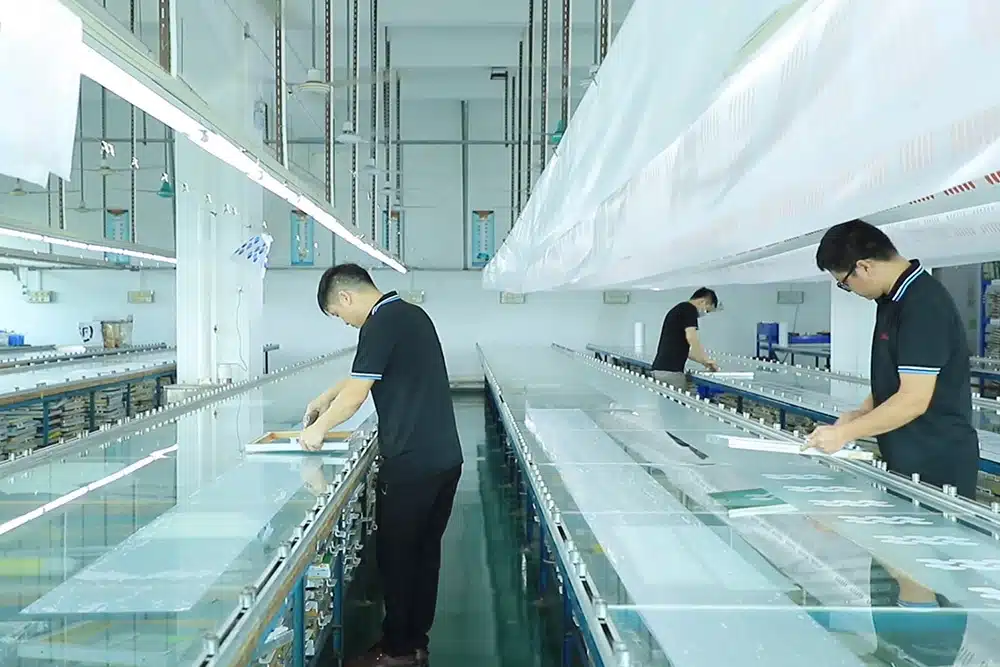

Silicone compression molding is a production process where a pre-weighed section of uncured solid silicone material is loaded into an empty open mold cavity which has been heated. Thereafter, the mold is closed by applying hydraulic pressure which causes the material to flow and fill the mold as heat causes vulcanization to occur, transforming the soft material into a stable and elastic component.
It is common when producing large quantities (volume) of solid silicone items like gaskets, mats, bottle seals, keypads and wearable parts. It is most compatible with the thicker-wall designs and fairly straightforward geometries in which full automation is not a requirement. Our silicone compression molding capabilities are optimized for these types of projects.
Although more automated processes have become popular, compression molding continues to be popular due to its cheaper initial tooling cost and increased versatility in handling particular families of parts. Most purchasers believe that compression molding will always be the least expensive solution as compared to LSR injection. As a matter of fact, cost efficiency varies based on the complexity of parts, cycle time, labour intensity and the tolerance requirements.
Silicone compression molding is not merely a cheap molding alternative to consider, it is a procedure that should be equipped with the right choice of material, mold design, and tolerances planning of realistic tolerance to provide stable mass production.
How Silicone Compression Molding Works (Step-by-Step Process)

Having spent years at the production floor, I can inform you that silicone compression molding is not as easy on paper as it seems but each and every step needs to be strictly regulated. Minor changes in weight, temperature or venting soon become scrap or expensive rework. Proper control of silicone compression molding process parameters is essential for consistent results.
Material Preform Preparation
Uncured silicone compound is sliced or weighed by operators into preforms which are accurate in volume and match the volume of the cavity and calculated flash allowance. Weighing is essential, even a 5 percent deviation would result in short shots or flash.
Mold Loading
The preform is then inserted by hand into the lower cavity of a preheated two or multi-plate mold. Adequate positioning eliminates folding or trapping of air.
Heat and Pressure Vulcanization
The pressure is below 100-200 tones (depending on the size of the part and the number of cavities) at 160-200 o C in order to close the mold. Within 30-180 seconds, crosslinking takes place, which is based on the amount of material thickness and formulation.
Demolding and Flash Trimming
The part is then removed and after curing the mold opens. Oversized flash is cut off by machine or by hand with automated knives.
Post-Curing (When Required)
Food-contact, medical or high performance parts are commonly subjected to a convection oven at 200 o C, 2-4 hours to eliminate any residual volatiles and to stabilize mechanical properties.
The following are the stages that can be followed in practice:
| Process Stage | What Happens | Risk Factors | Quality Control Focus |
| Preform Cutting | Material weight control | Inconsistent volume | Weight tolerance (±1–2 g) |
| Mold Closing | Compression under heat | Air traps | Venting design |
| Vulcanization | Crosslinking reaction | Under/over cure | Temperature & time control |
| Demolding | Part release | Tear or deformation | Draft angle & surface finish |
| Trimming | Flash removal | Surface damage | Manual vs automated trimming |
It has a high involvement of labor particularly during loading and trimming. Part-to-part consistency is completely dependent on the temperature of the mold in all the cavities.
Cost Structure of Silicone Compression Molding
The actual silicone compression molding price per unit is not most of the time the one on the initial price quote. Tooling can be deceptively cheap, however, workforce and cycle time tend to rule the roost when quantities rise to more than several thousand units. This makes it a strong option for producing custom silicone parts cost-effectively.
| Cost Element | Impact Level | Explanation |
| Tooling cost | Medium | Usually lower than LSR because molds are simpler steel or aluminum plates |
| Cycle time | High | Directly affects unit price — longer cure times increase machine hours |
| Labor | High | Manual loading, unloading, and flash trimming are the biggest drivers |
| Material waste | Medium | Flash and edge wastes may reach 1525 percent on complicated designs. |
| Post-curing | Variable | Adding energy and cost, required food/medical grades. |
Compression molds are simpler to mechanically control than LSR injection molds, but much more dependent on labor. The complicated geometries drive up the cost of trimming very high. The high cavity can reduce the unit price, but it will increase the compression molding tooling price and will demand more control of the process. When purchasing a manufacturer of custom silicone compression molding, always request that a cost breakdown be provided as opposed to the cost in units.
Design Tips to Improve Moldability and Reduce Defects

Early DFM choices can save a smooth production process and months of engineering repairs and ships that are rejected. Our detailed design tips for successful silicone compression molding can help you avoid common pitfalls.
Draft Angles
Use 1-3 degrees of draft according to the depth and surface texture. Zero-draft walls virtually ensure tearing in the demolding of higher sections.
Wall Thickness
Make uniformity of thickness. Rapid transitions between 1 mm and 6 mm result in variations in the rate of curing which results in internal stress, sink or voids.
Undercuts
Undercuts should be assessed. It is possible to strip the minors by hand but deep or multiple undercuts soon render the process unprofitable and augment the defect rates.
Venting Design
Vent lines and parting-line vents are not to be compromised. Even with ideal material flow you will find air traps, burns or partially filled up even with perfect flow.
Best practices versus pitfalls:
| Design Factor | Recommended Practice | Common Mistake | Resulting Defect |
| Draft angle | ≥1° (up to 3° for deep draws) | No draft or negative draft | Tearing on demolding |
| Thickness | Uniform throughout | Sudden variation | Sink marks or voids |
| Undercuts | Evaluate early for mold complexity | Ignored until tooling stage | High trimming cost |
| Venting | Full perimeter vent lines | Insufficient or blocked vents | Air trap / burn marks |
Typical Tolerances in Compression Molded Silicone Parts
The tolerances in silicone compression molding are broader than is typically anticipated by engineers when they initially switch to plastics or LSR. Thermal expansion of the mold itself (1.5-3.5% according to the compound) and the shrinkage must be taken into consideration.
| Part Size | Typical Tolerance | Risk Level |
| <50 mm | ±0.2–0.3 mm | Low |
| 50–150 mm | ±0.3–0.5 mm | Medium |
| >150 mm | Case-dependent | High |
Compression molding should not be used with ultra-tight tolerance micro-components or parts with large surfaces of +0.05 mm across. LSR injection or secondary machining will be needed in case the drawing of the drawing requires that. This is particularly relevant when designing custom silicone seals.
Common Defects in Silicone Compression Molding

The most common problems that I encounter in the incoming production audits include:
- Flash — Extraneous material at the line of separation that has been introduced by excess pressure, worn edges of mold or improper weight of preform.
- Air traps / Burn marks – This is air that is unable to escape and results into incomplete fill or burning.
- Cuts shots -Lost passages of the film as a result of the lack of content or the passage of heat.
- Warping / Deformation – The result of the uneven cooling or the over-shrinkage after the cure, or the wrong method of demolding.
- Surface marks Surface marks – dirty molds, insufficient release agent, or rough polishing of the mold.
Virtually all of these flaws can be identified as having been determined at the design or mold-build stage and not on the production floor.
When to Choose Compression Molding Over LSR Injection

The choice of compression molding or LSR injection must not be influenced by price headline but by part geometry, volume, and tolerance requirements. For a full comparison, read our guide on compression molding vs LSR injection.
| Factor | Compression Molding | LSR Injection |
| Tooling cost | Lower | Higher |
| Automation level | Low (manual loading) | High |
| Tolerance control | Moderate | Better |
| Material type | Solid silicone | Liquid silicone |
| Ideal for | Medium-complexity parts, thicker walls | High-precision, thin-wall, complex geometries |
Use compression molding in those cases where your component has higher density, tolerances of ±0.3 mm are acceptable, and where the annual volume of the component justifies not the cost of LSR tooling and cold-runner. Use LSR where tighter tolerances, clean flash-free edges or high-volume production that is fully automated are required.
Conclusion — Compression Molding Is Simple, But Not Forgiving
Thousands of custom silicone parts manufactured daily continue to be reliable and economical using silicone compression molding. Its success, however will entirely rely on correct DFM planning even at the initial drawing.
The cost advantage seeming to be apparent will go away within a short time provided that excessive trimming work is overlooked or defects are left to recur. Most of the headaches of mass-production are prevented by realistic tolerance planning and prior consultation on the design of moulds. Strong quality control throughout the process ensures reliable long-term results.
Compression developing should be approached as a trained procedure instead of an economical concession, and will provide reliable, consistent outcomes over several years.