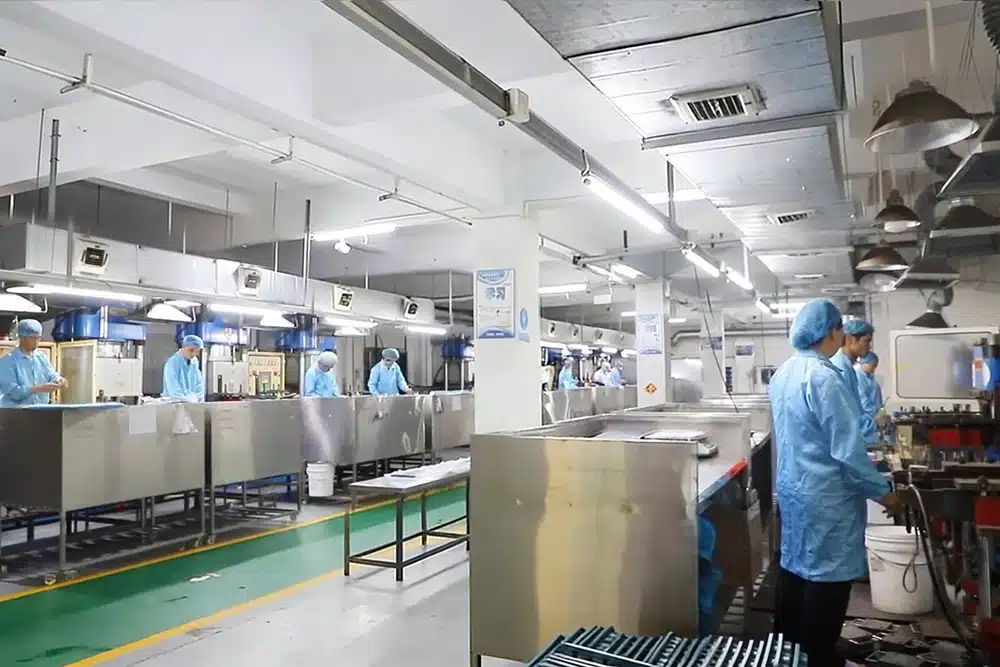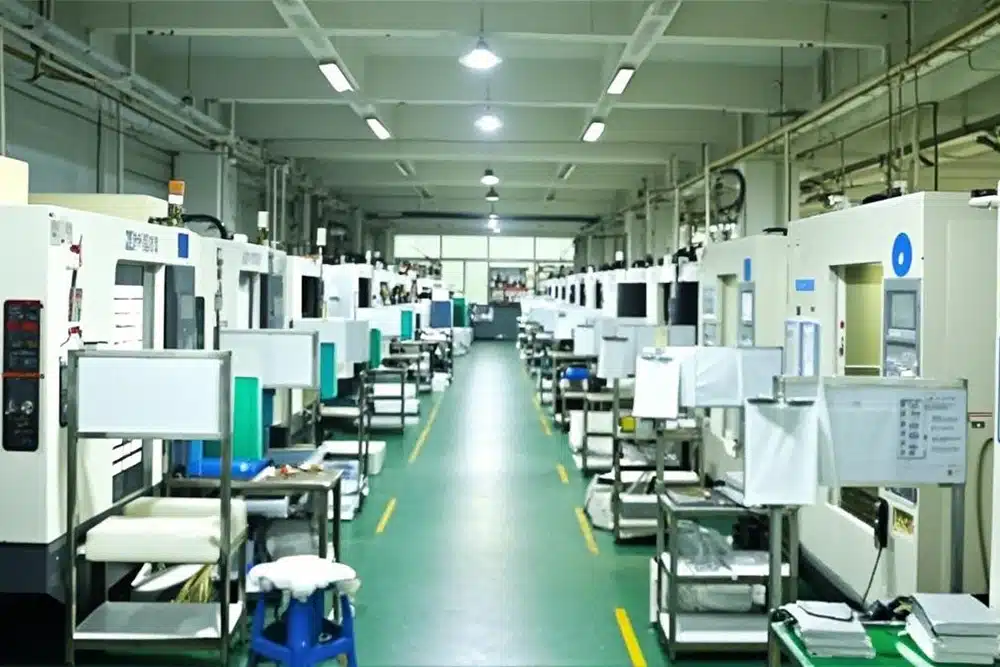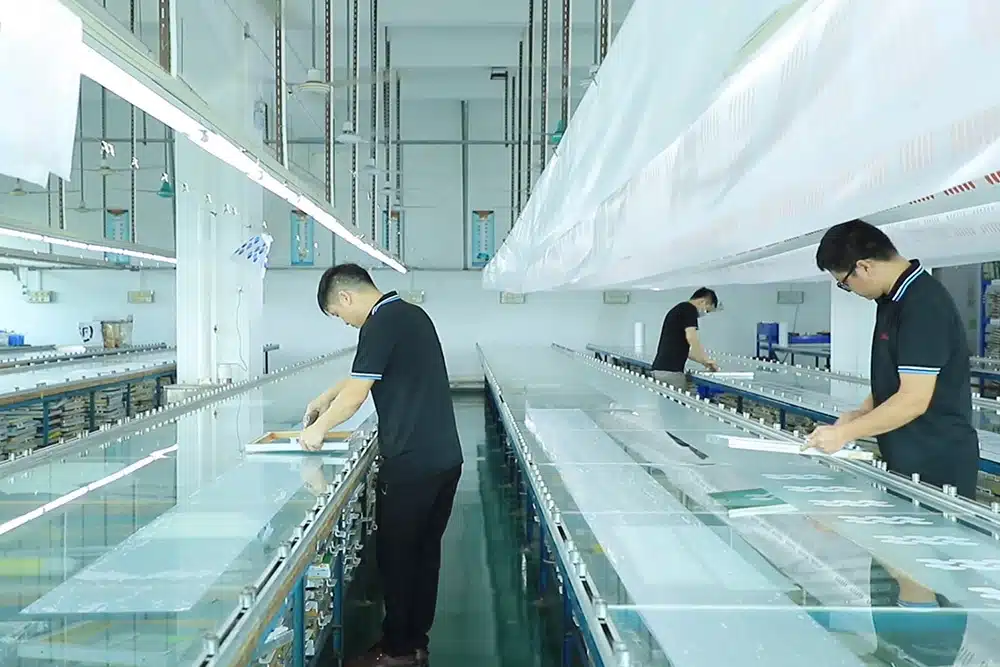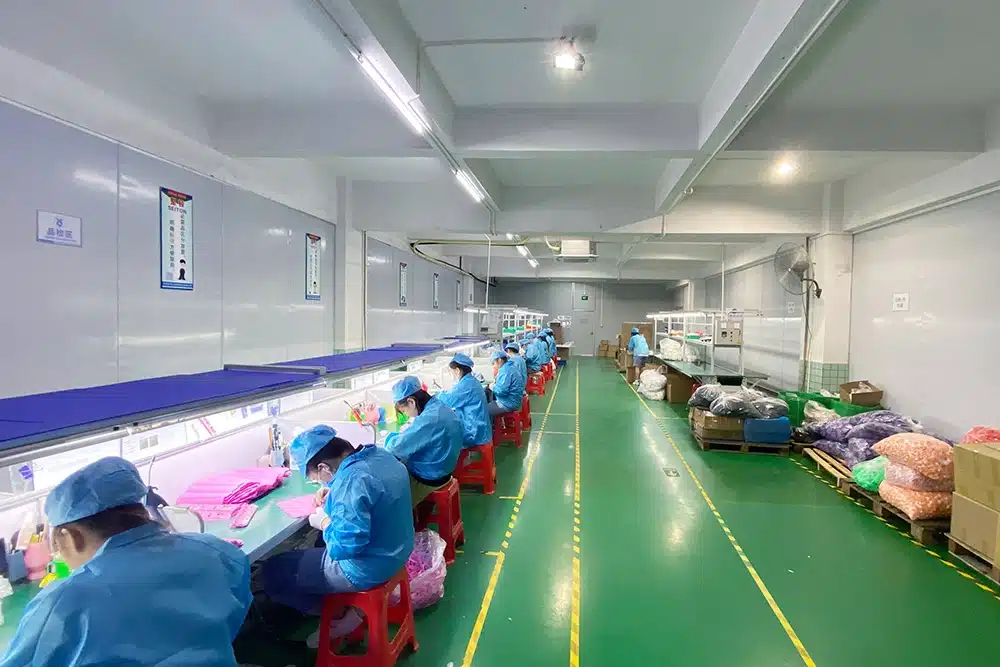

Smart production and automation enhance silicone quality control by providing more consistent, measurable, and trackable production parameters, inspection data, batch information, and process variations throughout the production process. For silicone products with custom shapes, even small differences in molding temperature, pressure, or material transfer could result in variations in dimensional accuracy, surface quality, or product performance. By integrating controlled manufacturing equipment with digital monitoring and good manufacturing practice, manufacturers can reduce variability of repeatable operations while maintaining the need for highly skilled engineers and inspectors.
A practical automated silicone quality control system can link molding conditions, inspection data, batch tracking and packaging verification to help identify and troubleshoot quality problems.
Buyers often think automation delivers better quality. However, automation in silicone quality control does not make a difference without robust material control, accurate mold design and process parameters, proper training of operators, and rigorous manual inspections. Automation does not remove quality control; it improves the measurability, repeatability, and traceability of quality control, when integrated with sound engineering and inspection practices.
What Does Automation Mean in Silicone Quality Control?
Automation in the silicone industry is the use of equipment and digital systems that minimise manual variability during production, and smart production is the collection and application of process data in production. These systems do not replace talent but add to consistency in areas where human involvement adds variability.
| Concept | What It Means | Quality Control Value |
| Automated equipment | Machines or systems that reduce manual variation in production | Improves process consistency and repeatability |
| Smart production | Use of digital records, process data, and workflow control | Makes quality issues easier to track and analyze |
| Process monitoring | Tracking temperature, pressure, curing time, and cycle data | Helps detect abnormal production conditions early |
| Digital QC records | Recording inspection results and batch data electronically or systematically | Improves traceability and audit readiness |
| Standardized workflow | Defined production and inspection steps | Reduces operator inconsistency and missed checks |
| Human QC judgment | Engineer and inspector review of quality risks | Ensures automation decisions match real product requirements |
This approach enables silicone manufacturers to tightly manage complex processes like compression molding or co-injection silicone molding, while using expert review for final sign-off.
Why Automation Matters for Silicone Product Quality
Process variations can have a significant impact on silicone manufacturing because the material’s cure time, elasticity, and surface finish are all affected by temperature, pressure and time. Smart Production and automation reduce these variations during normal production, resulting in consistent results.
| Quality Challenge | How Automation or Smart Production Helps |
| Process variation | Keeps temperature, pressure, timing, and cycle settings more consistent |
| Manual operation errors | Reduces reliance on repeated manual judgment for routine tasks |
| Unstable curing | Helps monitor curing time and process conditions |
| Missing QC records | Creates clearer records for inspection and traceability |
| Batch inconsistency | Links production data with material and inspection records |
| Delayed defect detection | Supports earlier identification of abnormal trends |
| Mixed batches | Improves labeling, batch separation, and packaging control |
| Repeat-order variation | Allows previous process settings and records to be reviewed |

This can lead to more stability for OEM silicone manufacturing projects where the customer expects the same product performance from the first to the 1000th unit.
Key Areas Where Automation Supports Silicone Quality Control
The benefits of automation and smart systems are not just confined to the molding press: they can be used to aid in every step of producing a custom silicone product. The trick is to use them to standardise processes that can benefit from automation, while allowing humans to drive judgment calls.
| Production Area | Automation or Smart Control Method | QC Benefit |
| Material preparation | Batch labeling, weighing records, material status control | Reduces wrong material or mixed batch risk |
| Color mixing | Formula control and batch comparison | Improves color consistency |
| Molding process | Controlled temperature, pressure, time, and cycle settings | Supports dimensional and appearance consistency |
| Curing control | Time and temperature monitoring | Reduces under-curing or over-curing risk |
| Mold management | Mold number, maintenance records, setup confirmation | Helps trace tooling-related defects |
| In-process inspection | Defined sampling frequency and inspection logs | Detects defects before full-batch problems occur |
| Secondary processing | Standardized trimming, printing, spraying, or assembly steps | Reduces manual variation |
| Packaging | Label verification, carton records, batch separation | Prevents wrong shipment and traceability loss |
| Final QC records | Digital or structured inspection results | Supports buyer review and root-cause analysis |
These areas of silicone QC can all come together to make the QC process more consistent and communicable to OEM buyers and quality managers. This is particularly effective when combined with strong control of environmental factors in silicone manufacturing.
Automated Process Monitoring in Silicone Molding
Process monitoring is one of the most useful applications of automation in silicone QC because it affects a number of the variables that can affect part quality during silicone compression molding or co-injection molding.
| Monitored Parameter | Why It Matters for Silicone Quality |
| Mold temperature | Affects curing, surface quality, dimensional stability, and strength |
| Pressure or compression force | Influences filling, flash, bubbles, and product density |
| Curing time | Helps prevent sticky, weak, or under-cured products |
| Cycle time | Supports repeatability and production stability |
| Material loading amount | Reduces short molding, flash, or weight variation |
| Machine setting | Helps reproduce approved production conditions |
| Mold number | Links defects to specific tooling if issues occur |
| Operator and shift | Supports root-cause analysis if variation appears |
| Production date | Connects process data with batch traceability |

When production data is compared with the sample settings, it allows manufacturers to identify issues before they become problems rather than during the final inspection.
Smart Production Data and Batch Traceability
Smart production is most valuable when it links isolated data into a traceable workflow – from material to shipment. This is particularly important for regulated manufacturing and OEM orders.
| Data Record | How It Supports Traceability |
| Material batch | Identifies the source of raw silicone, pigments, additives, or inserts |
| Mold number | Helps locate tooling-related quality issues |
| Machine number | Helps compare output between different machines |
| Process parameters | Shows whether production followed approved settings |
| Production date and shift | Supports investigation of time-based variation |
| Inspection result | Confirms whether QC checks were performed and accepted |
| Packaging record | Links product batch to labels, cartons, and shipment details |
| Corrective action record | Shows how abnormal issues were handled and prevented |
The data approach enhances silicone batch traceability and reassures customers that any quality issues will be promptly and thoroughly examined.
Automation in In-Process Inspection and Defect Prevention
Rather than testing at the end of production, smart systems help the QC team detect trends during production through first pieces, patrols and real time data logging.
| In-Process QC Activity | How Smart Production Improves It |
| First-piece inspection | Records whether the first molded parts match approved standards |
| Patrol inspection | Ensures inspection happens at defined intervals |
| Sampling inspection | Helps track quality trends across the batch |
| Defect recording | Makes repeated issues easier to identify |
| Parameter comparison | Connects defects with temperature, pressure, curing, or machine settings |
| Abnormal escalation | Helps production teams respond before defects spread |
| Root-cause analysis | Uses records instead of guesswork to identify likely causes |
This type of inspection of silicone products is proactive and helps minimise waste and ensure quality in large production runs.
Smart Assembly and Packaging Control
Quality control continues after the parts leave the press. Digital control of assembly, labeling and packaging ensure product consistency, and avoid mix-ups and contamination that can be passed on to the consumer.
| Packaging Control Area | Quality Risk Reduced |
| Product status labeling | Prevents rejected or pending products from entering shipment |
| SKU/barcode verification | Reduces wrong product or wrong label errors |
| Batch separation | Prevents mixed colors, models, or production lots |
| Quantity control | Reduces shortage or overpacking issues |
| Carton record | Helps trace products after shipment |
| Clean assembly workflow | Reduces contamination and handling marks |
| Final release record | Confirms shipment is approved before delivery |

These processes are especially critical in the manufacture of multi-colored silicone products, overmolded components and consumer products such as kitchen and baby products. Our professional assembly and packaging control systems help ensure cleanliness, accuracy, and traceability at this final stage.
Automation for Different Silicone Product Types
The focus of automation can vary based on product types. The priorities for a silicone mat are different to those for complex automotive seals or baby products.
| Product Type | Automation or Smart QC Priority |
| Silicone mats | Dimensional consistency, surface quality, packaging flatness |
| Silicone kitchenware | Material control, color consistency, cleanliness, heat-related performance |
| Silicone baby products | Material records, cleanliness, softness, final inspection |
| Silicone pet products | Tear resistance, durability, batch consistency |
| Silicone sleeves/covers | Fit control, elasticity, dimensional inspection |
| Silicone seals/gaskets | Hardness, compression, dimensional and functional checks |
| Multi-color silicone products | Color placement, color separation, bonding consistency |
| Overmolded parts | Insert positioning, bonding quality, alignment, functional fit |
| Automotive components | Heat resistance, process stability, traceability records |
| Electronics accessories | Fit, cleanliness, color consistency, packaging accuracy |
This knowledge can help OEM buyers and product designers choose suppliers with smart manufacturing capabilities that match their product needs.
Benefits of Automation for OEM and ODM Silicone Buyers
For procurement specialists, quality managers and brand owners, automation is valuable because it delivers tangible benefits in terms of consistency, record-keeping and risk mitigation.
| Buyer Benefit | Practical Meaning |
| Better consistency | Products are made under more controlled and repeatable conditions |
| Improved traceability | Material, production, inspection, and shipment records are easier to connect |
| Faster problem solving | QC teams can review data instead of relying only on memory |
| Lower manual error risk | Standardized steps reduce skipped checks or mixed batches |
| Better repeat orders | Previous production data can guide future batches |
| More reliable scaling | Larger orders can be managed with clearer process control |
| Stronger supplier evaluation | Buyers can assess process discipline, not just product samples |
Such benefits help importers and distributors consistently meet brand requirements in re-orders.
Limitations of Automation in Silicone Quality Control
Automation and smart production have their advantages, but are not silver bullets. Some steps in the production of silicones still need skilled human intervention and engineering principles.
| Limitation | Practical Meaning |
| Automation cannot fix poor design | DFM review and mold engineering remain essential |
| Wrong material still causes problems | Material selection and incoming inspection are still needed |
| Data alone does not improve quality | Engineers must analyze records and take action |
| Some defects require human judgment | Appearance, feel, and flexibility may need trained inspectors |
| Custom projects vary widely | Automation must adapt to product structure and order volume |
| Operators still matter | Training and discipline are needed to follow standardized workflows |
Understanding these challenges helps buyers to manage expectations and look for suppliers that have both technology and process engineering capability.
How OEM Buyers Can Evaluate a Supplier’s Smart QC Capability
Rather than asking if the factory has automation, savvy sourcing managers ask questions that show how effectively the system is used to manage factory risks.
| Buyer Question | What a Qualified Supplier Should Demonstrate |
| What parameters do you monitor? | Temperature, pressure, curing time, machine, mold, and batch data where relevant |
| Do you keep production records? | Organized records linked to material and inspection data |
| Can batches be traced? | Material-to-production-to-shipment traceability |
| Do you perform first-piece inspection? | Early approval before mass production continues |
| Are in-process checks documented? | Defined inspection frequency and defect records |
| How are defects escalated? | Clear abnormal reporting and corrective action process |
| Is packaging controlled? | SKU, label, carton, quantity, and batch verification |
| How do you use QC data? | Root-cause analysis and improvement for future production |
Silicone suppliers who can answer these questions with real-life examples and easy-to-access documentation have the capabilities in silicone automation and process control. Our quality certifications further validate the effectiveness of these smart production systems.
Conclusion — Smart Production Makes Silicone QC More Measurable
Smart production and automation support better measurable, traceable silicone quality control. By linking process variables, inspection checklists, batch history, packaging information, and corrective actions, manufacturers can identify issues earlier in the process and help ensure more consistent OEM silicone manufacturing. But it still requires good engineering, inspection standards and quality management. By assessing suppliers on how they combine these tools with established production practices, OEM buyers and quality managers can minimise risks and deliver the consistent, high-quality results their brands demand. This approach is central to reliable custom silicone parts manufacturing at scale.