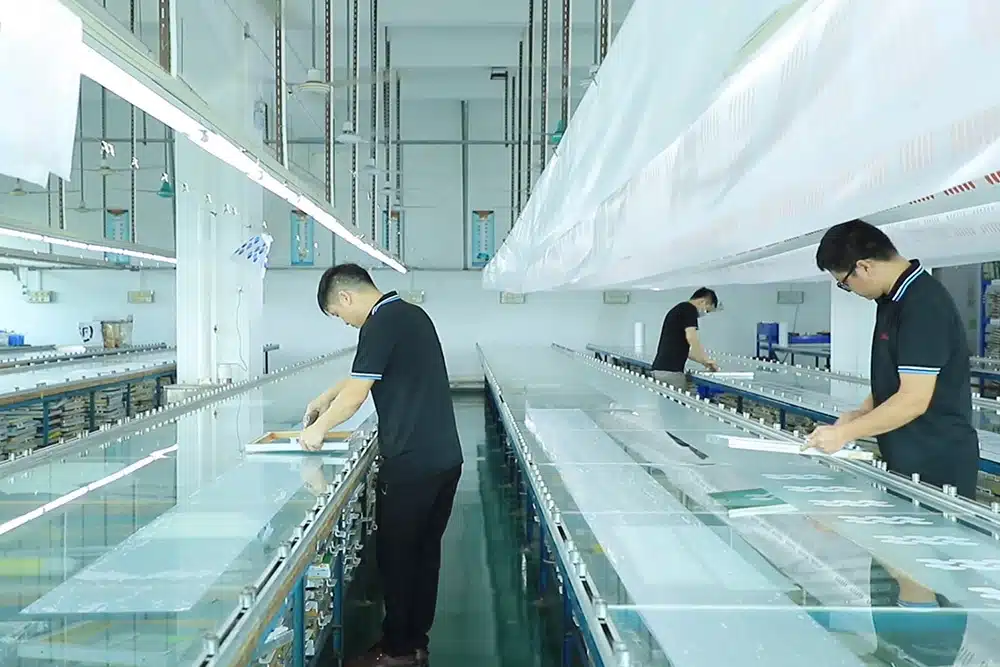

By selecting the proper quality control for silicone screen printed parts, you can avoid costly rejects, maintain your brand’s image and ensure that you get consistent results from the first part to the last. Unlike the rigid plastic or fabric, silicone is flexible and has some surface characteristics that affect the bond between the ink and the surface and the registration and durability of the printed image. A QC checklist bearing on silicone screen printing will detect issues early and maintain quality during the printing process.
We have been working with custom silicone products for automotive, kitchenware, pet, and promotional products for years, and have fine-tuned our process to give you the best possible products. This easy-to-use checklist is ideal for engineers, sourcing managers and QC to ensure accurate and consistent results, with reduced defects through pre-production to outgoing inspection.
Pre-Production Controls Before Any Printing Starts
The quality of a good start, long before the ink even comes into contact with the silicone. If not attended to, some may have the same misaligned expectations which will lead to rework at a huge cost later.
Verify Silicone Substrate and Surface Preparation Plan
Make sure that the silicon grade, durometer (hardness) and surface condition are suitable for the project. With printed parts surface preparation is important because silicone does not stick to itself.
Check the following:
- Obtaining material certification (food-grade, medical-grade or industrial).
- Surgical site infection as for clean and post clean status (if applicable)
- Type of surface treatment applied to specify the surface to be coated: plasma, mechanical abrasion or primer.
- Each lot of production has a smooth surface treatment.
Avoid “wiping.” Repeatable preparation plan is recorded and implemented every time.
Artwork, Color, and Printing Specification Review
Specifications should be clear to avoid ambiguity. Talk about vector artwork, Pantone colour references, placement drawings, tolerances of position, size and registration.
This will prevent problems when prints don’t match at a later time with ambiguous terminology. Keep documentation and share with the whole production team.
First Article Inspection (FAI) for Silicone Screen Printed Parts
The first article inspection is an opportunity to check that the whole set up is correct prior to mass production. Documenting our surface preparation, curing and inspecting process in silicone screen printing is the only way we can achieve a stable FAI; otherwise the process is dependent on the habits our silicone screen printing process is documented from surface preparation through curing and inspection, instead of relying on operator habits.
Visual and Dimensional Checks on the First Printed Parts
Check under the appropriate light for the following conditions in each of the first article samples:
- Full ink coverage, sharpness of ink.
- There are no pinholes, smudges or bubbles found.
- Registration & accurate colour matching in multi-colours.
- Edge without bleeding, clean edges.
- The imperfection that exists on the surface of silicon.
Compare the position of the printed logo with the datum points and dimensions of printed area and alignment on curved/3D surfaces. Capture an image of each sample and make measurements for future reference.
Functional Tests: Adhesion, Flexing, and Basic Durability
Do these simple, but important tests:
- A test for the strength of the tape in support of an object.
- A series of soft flexes to simulate use
- Light scratch resistance
- Use suitable detergent or approved wipe test solution.
The checks are used to help detect weak prints prior to scaling up. Get the results and document clearly for making immediate changes if necessary.
In-Process Quality Control During Mass Printing
FAI is followed by a consistent quality, no drift in production and hundreds or thousands of parts are produced.
Start-of-Shift and Changeover Checks
Prior to change of shift or after the set-up:
- Print and sign a test sample.
- Test batch of inks, mixing ratio and viscosity
- Check the temperature and time for setting
- Check the alignment and condition of fixtures.
Sampling Frequency and Critical Parameters to Monitor
Set up a viable sampling plan for the production volume and risk of contamination (usually 30-60 minutes, or 50-100 pieces).
Monitor:
- Place and align prints.
- Color consistency
- The degree of adhesion on samples parts.
- The force with which the mesh presses ink onto the paper and the flow of ink through the mesh.
Record the changes in the parameters; this will make it easier to pinpoint the problems.
Final Inspection Before Packing and Shipment
Last and most importantly, a final inspection is performed to ensure that all components sent out meet agreed standards – especially important when sending to export orders and OEM clients.
Visual Acceptance Criteria for Printed Silicone Parts
Establish explicit acceptance criteria with agreed upon samples:
- Acceptable: Minor, noncosmetic variations are acceptable.
- Accept: If the lines are aligned and there are no heavy print smudges and peeling, it is acceptable.
Ensure that A/B reference samples are used to ensure that inspectors use the same judgment and not their opinion.
Sampling Plan and Documentation
Implement an appropriate sampling plan for the product risk level based on AQL. On each batch inspected record:
- Making sure that the batch number and the production date are not overlooked.
- Ink lot information
- Investigator’s name and results.
- Any variations and corrective measures
This documentation will help you with the complete traceability if you have any questions after delivery.
Suggested QC Checklist Table for Silicone Screen Printed Parts
| Stage | Check Item | Method / Tool | Notes |
| Pre-Production | Silicone grade & surface prep plan | Specification review | Confirm treatment method |
| Pre-Production | Artwork, color, placement tolerances | Digital files & prints | Approve Pantone references |
| FAI | Visual coverage, sharpness, registration | Visual + magnifying lamp | Photograph all samples |
| FAI | Adhesion & flex test | Tape test + manual flex | Document results |
| In-Process | Start-of-shift sample approval | Printed test part | Check ink & curing settings |
| In-Process | Position & color consistency | Every 30-60 min sampling | Record any adjustments |
| Final | Overall visual acceptance | Reference samples | Define clear pass/fail criteria |
| Final | Traceability documentation | Batch records | Include ink lot & inspector ID |
How Buyers Can Use This Checklist with Their Suppliers
This checklist can be passed on to silicone manufacturers by the overseas buyer or brand owner to ensure expectations are set from the beginning. Discuss and revise it as a group, not as an individual.
Having the final agreed version included in your purchase order/quality agreement helps to reduce misunderstandings to a minimum and helps to speed up approvals.
Summary — Consistent Quality Comes from Controlled, Repeatable Checks
The silicone screen printed parts must be systematically controlled in the whole production process in order to produce reliable parts. These easy steps will help factories and buyers to minimize defect rates, maintain brand reputation, and build trust in their supply chain.
This checklist can be used as a “living” document to continually evolve as a result of actual plants and data! With both parties having well defined and documented processes, we should be able to see consistently excellent silicone components both in terms of performance and appearance.