
Custom silicone sleeves for stainless steel bottles and tumblers are molded silicone accessories that enhance grip, safeguard the most frequently used surfaces from scratches and regular wear and tear, decrease the risk of slipping on smooth metal surfaces, and boost brand identification. Stainless steel bottles and tumblers are long-lasting and are made in high demand for their insulation and durability, but they aren’t the most comfortable to hold because they can slip or become sticky when cold or wet, and the base can easily be scratched or marked by tables and counters.
When creating stainless steel bottle and tumbler projects, a silicone sleeve should be conceived to enhance grip, base protection, handling comfort and brand presentation, rather than just for the sake of decoration and color banding. For a broader framework, see this silicone sleeve design guide.. The right design will depend on the bottle diameter, the bottle taper, the bottom radius, the wall thickness, the hardness of the silicone, the sleeve coverage, the texture and placement of the logo and packaging format. The fit, grip, edge stability and appearance of logos cannot be properly verified from drawings only; therefore, real samples must be approved prior to mass production to ensure that the bottle will meet the requirements of the buyer. That many buyers think one silicone sleeve will fit many stainless steel bottles is not true for real custom development as it must consider actual diameter, taper, surface finish, base shape, installation path and tolerance range of the stainless steel bottle.
Why Use Silicone Sleeves for Stainless Steel Bottles and Tumblers?
Silicone sleeves deliver tangible improvements in usability and market appeal for stainless steel drinkware that go far beyond simple decoration. For drinkware brands developing insulated bottles, tumblers, shaker bottles, or promotional metal drinkware, custom silicone sleeves for stainless steel bottles should be designed around the real product diameter, taper, base profile, texture needs, logo method, and packaging plan.
They increase traction on smooth or coated stainless steel surfaces, improve traction when bottles are wet or used outdoors, prevent contact marks and small bumps to the base of the bottle, can help reduce noise on hard surfaces, and can reduce scratches on lower body surfaces. In addition, they introduce colour, texture, logo branding without modifying the steel structure and thereby contribute to the development of product families or promotional editions. It is their fit, texture, material feel and colour stability that makes them valuable.
| Buyer Goal | How Silicone Sleeves Help Stainless Steel Drinkware |
| Better grip | Silicone texture and flexibility improve handling on smooth metal surfaces |
| Base protection | A silicone boot can reduce direct contact with tables, counters, or hard surfaces |
| Scratch reduction | Sleeve coverage helps protect common contact areas from daily wear |
| Noise reduction | A soft silicone base can reduce metal contact noise |
| Brand differentiation | Custom color, logo, and texture create stronger product identity |
| User comfort | Silicone adds a softer grip area for daily handling |
| Product collections | Multiple colors can support product families, seasonal lines, or size ranges |
| Retail value | A well-designed sleeve can make drinkware feel more complete and premium |

Common Stainless Steel Drinkware Products That Use Silicone Sleeves
Each stainless steel drinkware type has its own geometry and use requirements and the sleeve design should be flexible to meet those requirements. For example, insulated water bottles, which are commonly used on a daily basis, require proven base protection to handle the challenges of everyday use; sports bottles, meanwhile, call for firm wet-hand grip and outdoor durability. This match is a crucial one to get correct in the early stages to prevent need for later revisions.
Tapers and cups are also important factors in tumblers and travel mugs, while kids’ bottles are more concerned with softness and safe surface materials that are easy to clean. Consistency of brand and colour throughout the line is important for promotional and retail gift sets to ensure a strong visual identity on shelves or in e-commerce promotions.
| Product Type | Common Sleeve Purpose | Design Notes |
| Insulated water bottle | Base protection, grip, and color identity | Bottom diameter and coating finish should be checked |
| Stainless steel tumbler | Anti-slip base and handling comfort | Taper and cup holder fit may matter |
| Coffee tumbler | Grip, heat/cold handling comfort, and branding | Sleeve thickness and hand feel should be tested |
| Travel mug | Base protection and retail appearance | Handle or lid clearance may need review |
| Sports bottle | Wet-hand grip and outdoor durability | Texture and weather resistance may be important |
| Shaker bottle | Grip and sporty brand identity | Texture and cleaning should be considered |
| Kids’ bottle | Soft grip and base cushioning | Material safety and easy cleaning matter |
| Wide-mouth bottle | Lower body or base sleeve | Installation path and stretch should be reviewed |
| Promotional bottle | Logo visibility and cost control | Simple sleeve structures may be more practical |
| Retail gift set | Visual consistency and packaging | Color matching and packaging should be planned early |
Base Boot, Grip Band, Half Sleeve or Full Sleeve: Which Design Should You Choose?
Each stainless steel drinkware type has its own geometry and use requirements and the sleeve design should be flexible to meet those requirements. For example, insulated water bottles, which are commonly used on a daily basis, require proven base protection to handle the challenges of everyday use; sports bottles, meanwhile, call for firm wet-hand grip and outdoor durability. This match is a crucial one to get correct in the early stages to prevent need for later revisions.
Tapers and cups are also important factors in tumblers and travel mugs, while kids’ bottles are more concerned with softness and safe surface materials that are easy to clean. Consistency of brand and colour throughout the line is important for promotional and retail gift sets to ensure a strong visual identity on shelves or in e-commerce promotions.
| Sleeve Type | Best For | Buyer Consideration |
| Base boot | Bottom protection, anti-slip placement, noise reduction | Limited sidewall coverage |
| Grip band | Improved handling and lower material use | Less protection than a larger sleeve |
| Half sleeve | Balanced grip, lower-body protection, and branding | Practical for many bottles and tumblers |
| Full sleeve | Strong visual identity and more surface coverage | Higher material use and more complex fit |
| Open-bottom sleeve | Lighter structure and easier drainage | Less base coverage |
| Closed-bottom sleeve | Better base protection | Requires careful fit and installation testing |
| Reinforced base design | Better daily-use cushioning | Adds material and may affect packaging size |
| Tapered sleeve | Tumblers or angled bottles | Requires accurate product geometry |
Key Design Factors for Stainless Steel Bottle and Tumbler Sleeves
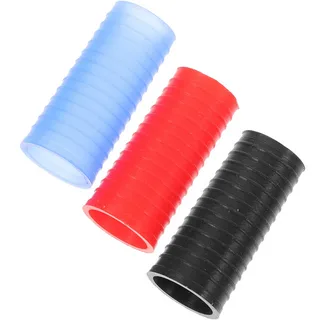
It’s not the biggest sleeve that’s necessarily the best sleeve to choose—it depends on the functional requirements, brand objectives, and the economic factors involved in production. For an insulated bottle, a simple base boot may be enough, or a full sleeve may make for an interesting statement for high-end tumbler lines.
Open bottom designs help with drainage and lighten the load while closed bottom or reinforced options provide more cushion and need to be fit-tested properly. The right Shore A hardness also plays a major role in sleeve retention, cushioning, and installation feel. Care must be taken in the retention and edge stability of tapered tumblers, or they may roll or shift when being used.
| Design Factor | Why It Matters for Stainless Steel Drinkware |
| Product diameter | Determines sleeve inner size and fit |
| Tapered shape | Affects sleeve retention and edge stability |
| Base profile | Important for silicone boots and bottom sleeves |
| Surface finish | Smooth, polished, or powder-coated surfaces affect grip |
| Sleeve coverage | Defines protection area, material use, and appearance |
| Wall thickness | Affects cushioning, cost, hand feel, and installation |
| Shore A hardness | Influences flexibility, grip, and shape retention |
| Texture design | Helps prevent slipping on smooth metal surfaces |
| Edge structure | Reduces rolling, lifting, or deformation |
| Cup holder fit | Important for tumblers and travel mugs |
| Logo placement | Must remain visible and undistorted on curved surfaces |
| Packaging size | Sleeve thickness may affect retail or ecommerce packaging |
Material and Shore A Hardness Selection
The first step to a successful silicone sleeve for stainless steel drinking bottles is geometry. All of the information, including diameter, taper, surface finish, etc., has an impact on the performance of the sleeve in practice and on its ability to be installed on the production line.
Together, wall thickness and Shore A hardness provide the ideal cushion and hold for the shoe. The placement of the texture, edge design and application of the logo should also account for the curvature and stretch when it fits. The size of the pack after sleeve installation is important for retail/ecommerce compliance; these should be discussed together from the beginning.
| Material / Hardness Choice | Practical Effect for Bottles and Tumblers |
| Food-grade silicone | Useful when required by drinkware claims or buyer documentation |
| General silicone | Suitable for external protective sleeves when special compliance is not required |
| Softer silicone | Better flexibility and grip, easier installation |
| Medium hardness silicone | Balanced fit, grip, and shape retention |
| Firmer silicone | Better structure but may be harder to install |
| Thicker silicone wall | Better cushioning and premium feel |
| Thin silicone wall | Lower material use but less protection and stability |
| UV/weather-resistant silicone | Useful for outdoor, sports, or camping drinkware |
| Easy-clean surface | Supports reusable drinkware and daily handling |
Grip Texture and Surface Finish Options
Always selecting the softest or firmest material, or hardness, is not the best choice; the selection should match the environment in which the material will be used, its grip and the expectations of the target market. When a brand advertise a specific claim, or it sells in a regulated market, food-grade silicone is indispensable, but general purpose compounds can be used for the external protective sleeves.
Softer durometers improve flexibility and installation on tapered bottles while medium or harder models provide increased shape retention during successive handling. The final hand feel and cushioning is also affected by wall thickness. UV-resistant compounds help retain colour and performance over time for drinkware used outdoors or for sports and easy-clean surfaces for daily use.
| Texture / Finish Option | Best For | Buyer Notes |
| Matte texture | Premium feel and practical grip | Good balance of appearance and handling |
| Ribbed texture | Strong directional grip | Depth should be comfortable for daily use |
| Dotted texture | Decorative grip surface | Works well for brand patterns |
| Grooved texture | Anti-slip handling | Deep grooves may be harder to clean |
| Raised pattern | Grip plus visual differentiation | Must be planned during mold design |
| Smooth finish | Minimalist appearance | Fit and hardness become more important |
| Soft-touch finish | Premium hand feel | Durability and cleaning should be tested |
| Wet-use texture | Sports bottles and outdoor tumblers | Test with condensation and wet hands |
Logo, Color and Branding Options for Stainless Steel Drinkware Sleeves
Texture is particularly important on stainless steel because many surfaces are smooth or coated and thus provide little natural grip. Matte finishes offer a high-end, non-slip texture without sensation of being too aggressive, while ribbed or dotted surfaces offer directional control, even when condensation from cold drinks is present.
The selected texture should also take into account the convenience of cleaning and methods used for the logo. While deep grooves can hold onto residue in sports bottles, subtle raised patterns can serve as a functional grip and as brand identifiers. Wet hands testing and real use testing maintain the final surface to be comfortable and perform the tasks needed.
| Branding Option | Best For | Buyer Notes |
| Pantone color matching | Brand color consistency | Physical color approval is recommended |
| Embossed logo | Durable molded branding | Must be planned before mold development |
| Debossed logo | Subtle premium appearance | Depth and cleaning should be reviewed |
| Silk screen printing | Simple logo or text contrast | Adhesion and wear should be tested |
| Laser engraving | Precise markings on suitable surfaces | Contrast depends on silicone color and finish |
| Texture branding | Grip plus visual identity | Pattern depth should feel comfortable |
| Seasonal colors | Retail collections and limited editions | Color MOQ should be discussed early |
| Retail packaging | Complete product presentation | Packaging should match sleeve color and brand positioning |
Mold Development and Sampling for Stainless Steel Bottle Sleeves
With silicone sleeves, stainless steel drinking vessels can be customized, making them a great way to distinguish them from other items in the retail store or on the internet. The Pantone matched colours help to maintain consistency across the brand, whereas embossed or debossed logos offer a tactile brand mark that lasts through daily use.
Silk screen printing is ideal for multi-color designs on flat surfaces, while laser engraving is the choice for accurate and permanent details on appropriate surfaces. Grip pattern can be combined with visual identity via texture brands and seasonal color can be used in limited editions. When installing a logo on curved surfaces, it is necessary to test it carefully to prevent distortion after stretching and installation.
| Development Step | What Happens | Buyer Checkpoint |
| Product review | Manufacturer checks diameter, taper, base shape, and surface finish | Provide real bottle or tumbler sample if possible |
| Sleeve design | Coverage, thickness, texture, logo, and color are planned | Confirm design before tooling |
| Mold design | Tooling is developed around sleeve geometry | Review critical fit and branding areas |
| Trial molding | First silicone samples are produced | Test real material behavior |
| Fit testing | Sleeve is installed on actual bottle or tumbler | Check sliding, tightness, and edge stability |
| Grip testing | Users handle the product in dry, wet, or cold conditions | Confirm texture and comfort |
| Cup holder test | Tumbler sleeve is checked for practical use where relevant | Confirm sleeve thickness does not create problems |
| Sample approval | Buyer confirms fit, color, logo, and packaging | Approved sample becomes production reference |
Quality Control for Silicone Sleeves for Stainless Steel Bottles and Tumblers
The most important stage is the development of mould and sampling, as the dimensions, surface finish and tolerances of stainless steel bottles can vary significantly from one supplier to another and production run to another. Physical samples or detailed 3D CAD drawings can be reviewed early to avoid downstream fit issues that drawings can’t address, especially during sleeve mold development.
This usually involves a series of design confirmation, tool making, mold trials, and a number of fit-ups on real bottles or tumblers. At this stage, the testing includes grip testing, edge stability testing and cup holder compatibility testing. Once approved samples, they will be used as production reference for mass volumes.
| Quality Check | Why It Matters |
| Material verification | Confirms correct silicone grade, color, and hardness |
| Hardness testing | Ensures approved flexibility and grip are maintained |
| Dimensional inspection | Helps ensure consistent fit on bottles or tumblers |
| Product fit test | Confirms sleeve retention on smooth or coated metal surfaces |
| Edge stability check | Reduces rolling, lifting, or sliding risks |
| Base stability check | Important for silicone boots and bottom sleeves |
| Surface inspection | Checks bubbles, stains, marks, or uneven finish |
| Texture inspection | Confirms grip pattern consistency |
| Logo inspection | Ensures branding is clear and correctly positioned |
| Trimming check | Prevents rough edges and improves user experience |
| Packaging inspection | Ensures products are ready for retail or ecommerce delivery |
Common Mistakes When Designing Silicone Sleeves for Stainless Steel Drinkware
Silicone sleeve quality control is about quantifiable factors, which impact on the user experience and brand reputation. Material verification, hardness testing, dimensional checks take place at various stages, whilst fit testing of representative S/S bottles verifies performance in the real world.
Close attention is paid to edge stability, surface defects, texture consistency, and logo clarity. Final packaging checks is the process of ensuring that products are ready for retail or direct-to-consumer shipping. Comparing against the approved sample during production keeps the production standards set at sampling.
| Mistake | Better Approach |
| Designing from photos only | Provide drawings, measurements, or physical bottle samples |
| Ignoring product taper | Design around the actual bottle or tumbler shape |
| Making fit too loose | Test sleeve retention on smooth or coated stainless steel |
| Making fit too tight | Review installation path, hardness, and stretch requirements |
| Over-thinning the sleeve | Balance cost with grip, base protection, and stability |
| Assuming one sleeve fits all sizes | Confirm diameter, taper, and tolerance for each product |
| Ignoring cup holder fit | Test tumbler sleeve thickness in real-use scenarios |
| Choosing texture visually only | Test grip, comfort, cleaning, and wet-hand handling |
| Skipping sample approval | Check real fit, grip, logo, color, and packaging before production |
What Buyers Should Prepare Before Requesting a Quote
Sometimes, even seasoned sourcing teams miss a detail that results in a fit problem, higher cost, or delayed launches. One of the most common mistakes is using only product pictures or common dimensions, as stainless steel bottles come in many different tapers, base radius and surface finishes.
Sleeves that are too loose for polished metal, too tight for comfort, no consideration for cup holder clearance with tumblers, or no validation with real samples for logos in high-stretch areas are among the other common mistakes. Without physical sample approval of the drinkware, there will likely be surprises in mass production almost every time.
| Information to Prepare | Why It Helps |
| Bottle or tumbler sample | Allows real fit and grip testing |
| 2D/3D drawing | Helps evaluate dimensions, taper, base profile, and mold feasibility |
| Product diameter and height | Defines sleeve size and coverage |
| Surface finish type | Helps evaluate grip and fit on polished, coated, or brushed metal |
| Bottom radius / base profile | Important for silicone boot or bottom sleeve design |
| Sleeve coverage area | Determines material use, protection, and appearance |
| Wall thickness target | Affects cushioning, cost, cup holder fit, and installation |
| Hardness preference | Guides grip, flexibility, and structure |
| Color requirement | Supports Pantone matching and product branding |
| Logo file | Helps evaluate embossing, debossing, printing, or engraving |
| Surface texture | Affects anti-slip performance and user comfort |
| Quantity estimate | Helps evaluate tooling, MOQ, and unit price |
| Packaging requirement | Ensures sleeve and bottle fit final sales channel needs |
How to Work With a Manufacturer on Custom Stainless Steel Bottle Sleeves
Having full project information in hand helps manufacturers to provide precise pricing and design suggestions, instead of the typical “ballpark” estimate, and also speeds up any custom silicone sleeve quote process.The best way to convey geometry and tolerances is by using a physical bottle or tumbler sample with 2D drawings or 3D files, especially when planning how to customize a silicone bottle sleeve.
Surface finish type, desired sleeve coverage, wall thickness, hardness range, color requirements, logo files, estimate of quantities, packaging requirements all further narrow the scope of the proposal. Adding target market and any record keeping requirements for foods that may touch the consumer streamlines the process and minimizes back-and-forth.
| Manufacturer Capability | Why It Matters for Stainless Steel Bottle and Tumbler Sleeves |
| Engineering review | Helps prevent fit, taper, thickness, and installation problems |
| Material selection support | Matches silicone performance with drinkware use and target market |
| Hardness guidance | Balances grip, flexibility, protection, and sleeve retention |
| In-house mold capability | Improves control over fit, texture, logo, and production stability |
| Silicone molding experience | Supports consistent quality for custom molded sleeves |
| Surface finishing options | Enables logo, texture, color, and touch-feel customization |
| Sample development | Confirms real bottle or tumbler fit before mass production |
| Quality control system | Reduces risks related to size variation, sliding, defects, and poor appearance |
| Packaging support | Helps prepare products for retail, wholesale, or ecommerce channels |
Conclusion — Stainless Steel Bottle Sleeves Should Balance Fit, Grip and Brand Value
When thoughtfully designed around the actual product, custom silicone sleeves for stainless steel bottles and tumblers offer an improved grip, protection at the base, scratch resistance, user comfort, and appearance of the brand. Furthermore, they should never be marketed as being bottle-proof or scratch-proof under any condition; instead, they rely on correct geometry, material, and hardness choices, as well as careful selection of texture and coverage, and testing of samples.
Combined with diameter, taper, surface finish, wall thickness, hardness, texture, logo positioning and packaging, the sleeve is a viable addition that bolsters product identity and everyday use. Collaborating with a knowledgeable silicone sleeve manufacturer ensures that concepts are realized into dependable products for the market with few revisions and standard materials.