
The most frequent mistakes in the selection of silicone material are when teams select materials based on one apparent factor – such as hardness, price, or colour – rather than evaluating how they will be used, how they will perform, how they will fit with other processes, how they will comply, and how they will remain consistent in production over time.
The most frequent errors in silicone material choices include the choice of material by a single criterion (such as hardness), ignoring the actual working environment, focusing on cost alone, neglecting compatibility of the molding process, neglecting to test the material on a real-use sample, and forgetting to test the finished product on a real-use sample.
Most consumers tend to believe that it is easy to choose silicone material due to the fact that silicone is usually flexible, heat resistant and long lasting. In practice, even very different outcomes can be achieved with the help of silicone formulations, their hardness levels, curing systems, additives, and molding processes in real-life application.
An intelligent process of the selection of the silicone material reduces the delays of the sampling process, avoidable defects, and stable mass production at the start of the project.
Why Silicone Material Selection Mistakes Become Expensive
Mistakes in material selection turn out to be costly, since they tend to manifest themselves when the moulds are already formed, when the sampling, testing or early production have already been completed – when changes have now become even more difficult and expensive.
Unsuitable choice of material may influence the design of the mold, its curing, shrinkage, the quality of its surface, hardness, color, odor, and end result. The changes of the material after its tooling can lead to the need to adjust the mould, to take new samples, additional tests, or even delay the production. The high hidden costs of low-cost material can be defects, scrap, customer complaints, or compliance failure. Pre-vaulting of materials minimizes risk prior to incurred tooling and production investments.
| Mistake Area | Possible Cost Impact |
| Wrong hardness | Poor fit, weak sealing, deformation, or uncomfortable feel |
| Poor heat resistance | Product aging, cracking, warping, or failure |
| Process mismatch | Longer cycle time, unstable curing, or poor molding results |
| Compliance oversight | Failed testing, delayed shipment, or market entry risk |
| Surface incompatibility | Printing, coating, or logo adhesion failure |
| Late material change | New samples, mold modification, timeline delays |
Mistake 1: Choosing Silicone Material Based Only on Hardness
Hardness matters, but cannot be the sole factor in silicone material choice.
Hardness in the shore influences flexibility, grip, sealing, cushioning and shape retention. Two materials with equal hardness though might exhibit different performance depending on formulation, tear strength, elongation, curing system or filler content. The geometry of products also varies the sensation of hardness and actual performance in practice. A test under actual conditions should always be done on samples.
| Hardness-Based Decision | What May Be Missed |
| “We need 40 Shore A silicone” | Tear strength, elongation, compression set, and actual product geometry |
| “Softer is better” | Shape stability, assembly fit, and durability |
| “Harder means stronger” | Flexibility, comfort, sealing performance, and user experience |
| “Same hardness means same performance” | Formulation differences and process variation |
Mistake 2: Ignoring the Real Application Environment
The right silicone material is determined by the location of use of the product, contact points and stress that the product will be under after use.
It is important to heat, cold, UV, moisture, oils, chemicals, stretching, compression, friction, and cleaning methods. The requirements of indoor consumer products and automotive or industrial silicone parts are very different. Applications in food-contact, skin-contact, pet-use, and electronics have special safety and performance concerns. End-use conditions should be used to start the material selection, rather than general material descriptions.
The most frequent errors in the selection of silicone materials may be avoided, by examining the use environment, hardness requirements, molding process, surface finishing requirements and compliance expectations of the product before tooling is started.
| Use Environment | Material Risk If Ignored |
| High-temperature use | Aging, cracking, deformation, or loss of elasticity |
| Outdoor exposure | UV aging, color fading, or surface degradation |
| Oil or chemical contact | Swelling, softening, or reduced performance |
| Repeated compression | Poor rebound or sealing failure |
| Food or skin contact | Compliance, odor, or safety documentation issues |
| Electronics use | Insulation, heat resistance, or flame resistance concerns |
Mistake 3: Selecting Material Based Only on Price
The lowest-cost silicone material is not necessarily the lowest-cost material when defects, and testing delays, unstable production, and repeat-order inconsistency are taken into consideration.
Reduction in material cost may cause more scrap, rework, odor problems, color variation, or product complaints. An increase in the quality of material or the appropriateness of the material can lower the overall risk of the project. Cost must be considered along with yield rate, stability of production, testing needs, and repeatability in long-term. The comparison of the total manufacturing cost should be made by buyers and not material price alone.
| Price-Focused Decision | Hidden Risk |
| Choosing the lowest material quote | Higher defect rate or unstable quality |
| Reducing filler or formulation quality | Lower tear strength or shorter product life |
| Skipping testing to save cost | Compliance failure or customer complaints |
| Ignoring batch consistency | Color or hardness variation in repeat orders |
| Comparing only unit price | Missing tooling, scrap, and delay costs |
Mistake 4: Overlooking Manufacturing Process Compatibility
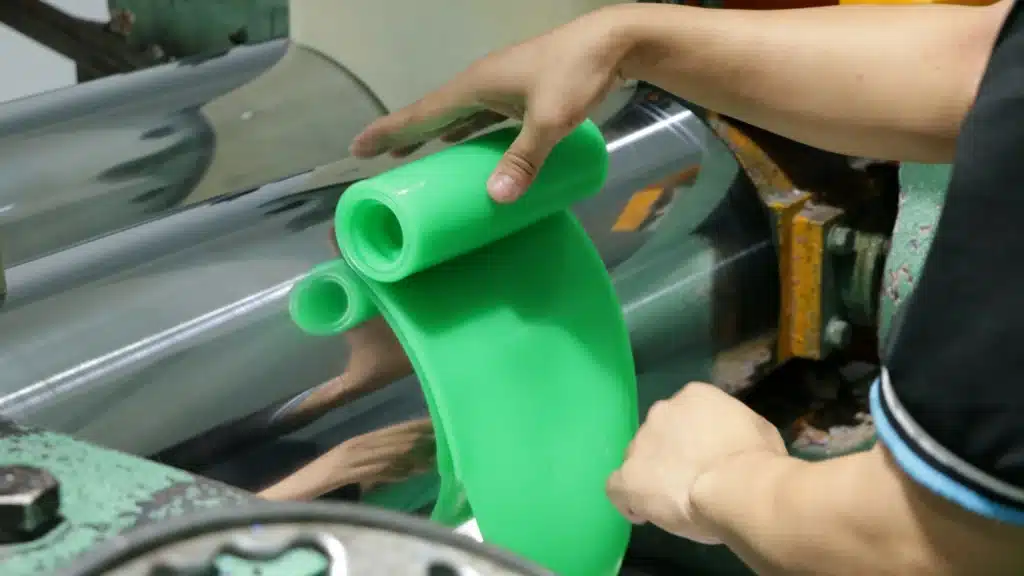
The silicone material should be compatible with the process of molding, part design, and production process or the product may be hard to produce in a continuous way.
Compression molding, transfer molding, and extrusion are all typical uses of solid silicone (HCR). Liquid silicone rubber (LSR) would be used in liquid injection molding, or high-precision automated production. Multi-color silicone products (co-injection or multi-color) demand compatible material and tight control of the process. Material selection is influenced by part thickness, undercuts, design of molds, behavior of curing, and finer details on the surface. The process mismatch can result in the incomplete curing, flash, deformation, bad surface quality, or not stable dimensions.
| Manufacturing Process | Material Selection Risk |
| Compression molding | Wrong hardness or curing behavior may cause deformation or flash |
| Liquid injection molding | Wrong LSR grade may affect flow, cycle time, or precision |
| Co-injection molding | Material mismatch can cause bonding or appearance issues |
| Extrusion | Poor formulation may affect profile stability |
| Surface-treated products | Material surface may not support printing, spraying, or engraving |
Mistake 5: Treating Food-Grade or Medical-Grade as Simple Labels
Application-specific testing, documentation, and production control should be used to support terms such as food-grade and medical-grade, rather than as an untyped material.
Food-grade silicone must be consistent with real food-contact operation, and market expectations. Medical-grade silicone relies on the proposed medical use, the type of contact, testing, and reporting. Pigments, additives, curing systems, and surface treatments may affect compliance. Purchasers must ensure the availability of the appropriate test reports prior to production and should never assume that food-grade automatically means that it is suitable for medical use.
| Label-Based Assumption | Practical Risk |
| “Food-grade means safe for everything” | It may not match medical or skin-contact requirements |
| “Medical-grade is always better” | It may be unnecessary or not aligned with food-contact testing |
| “FDA silicone” is enough information | The actual test and material scope may be unclear |
| “Color does not affect compliance” | Pigments and additives may need review |
| “Certificate is enough” | Product use and market requirements still matter |
Mistake 6: Forgetting Surface Finishing Compatibility
The choice of material should take into account surface finishing since printing, coating, spraying, and laser engraving rely on the behavior of surfaces of materials.
There are silicone surfaces that may need to be treated prior to printing or coating. Adhesion can be influenced by pigments, fillers, curing systems, and surface texture. Laser engraving might demand appropriate coloring contrast and heat reaction. Soft-touch coating, oil finishing and spray coating demand process compatibility. The issue on surface finish is usually encountered after samples have been looked at, which leads to delays.
| Surface Finish Requirement | Material Selection Consideration |
| Silk screen printing | Surface cleanliness and adhesion |
| Spray coating | Compatibility with coating and surface treatment |
| Laser engraving | Color contrast and heat response |
| Matte or soft-touch finish | Coating stability and touch feel |
| Multi-color appearance | Pigment stability and molding control |
Mistake 7: Confirming Materials Too Late
Assessment of silicone material following the development of the mold can pose unnecessary risk since the behavior of the material can impact the design of the mold, its shrinkage, curing and final size.
Material should be discussed before mold design. Hardness, shrinkage, flow, curing time, and surface finish have an influence on tooling. Late material adjustment may involve alteration of the mold, or the introduction of new samples. Material changes related to compliance can postpone approval or shipment. Early validation assists in the development of projects smoothly.
- Ensure environment in application and use beforehand.
- Pick candidate material prior to tooling.
- Sample performance and hardness in tests.
- Check compliance documents prior to production.
- Early approve color, surface finish, and formulation.
- Do not change the material unless there is a need after the mold validation.
Mistake 8: Skipping Real-Use Sample Testing
It is important to test the samples in the conditions of realistic use since the material performance cannot be accurately judged only by appearance or by hand feel.
Stretching, compression, heat, cleaning, repeated use, assembly fit, and user handling. To seal products, test compression set and rebound. In the case of consumer goods, test odor, color stability, surface feel and durability. Confirm documentation, and test requirements, of food-contact products or skin-contact products. The testing ought to be in line with the ultimate product usage.
| Product Type | Suggested Sample Evaluation |
| Silicone seals or gaskets | Compression, rebound, fit, heat/oil resistance |
| Kitchenware | Heat resistance, odor, cleaning, deformation |
| Pet products | Tear resistance, bite resistance, durability |
| Wearable silicone parts | Skin comfort, flexibility, sweat/contact resistance |
| Electronics accessories | Dimensional fit, insulation, heat stability |
| Silicone sleeves | Grip, stretch recovery, surface feel, assembly fit |
Practical Checklist to Avoid Silicone Material Selection Mistakes
A checklist list is used to assist product teams to make material decisions based on evidence rather than assumptions.
| Question to Confirm | Why It Matters |
| What is the product’s real application? | Defines performance and safety needs |
| What environment will it face? | Identifies heat, UV, chemical, or moisture risks |
| What hardness range is needed? | Supports flexibility, sealing, grip, or shape retention |
| Which molding process will be used? | Ensures material-process compatibility |
| Are surface finishes required? | Prevents printing, coating, or engraving failures |
| Does the product need food, skin, or medical-related documentation? | Reduces compliance risk |
| What tests should be done before production? | Confirms real-world performance |
| Is the material suitable for repeat production? | Supports long-term consistency |
Conclusion — Better Material Decisions Reduce Production Risk
The errors in the choice of silicone material are typically avoidable. Hardly, price, label or appearance alone are the problems that are caused by a choice. A sound decision must take into account application, environment, performance, process, compliance, surface finishing and repeat production.
The choice of silicone material is no minor point at the bottom of the product development. It is a manufacturing choice that influences the mold design, sampling fitness, production efficiency, compliance, and long-term performance of the product. Through early detection of the most common errors and by incorporating a systematic evaluation procedure, product teams will be able to eliminate needless delays and develop more dependable custom silicon products.