
Meta Description (148 characters):
Learn how Shore A hardness affects silicone flexibility, sealing, durability, and tactile feel to choose the right durometer for your application.
Excerpt (62 words):
Shore A hardness determines how soft or firm silicone feels and performs. This guide explains what Shore hardness means, how it affects sealing, compression set, and durability, and how to select the correct silicone durometer for gaskets, phone cases, kitchenware, and industrial applications.
Shore Hardness Guide for Silicone (Shore A): How to Choose
Choosing the correct Shore A hardness for silicone is a functional engineering decision that directly impacts sealing reliability, durability, and product feel. Shore A hardness measures a silicone material’s resistance to indentation, essentially indicating its softness or firmness on a scale from 0 to 100. Lower values mean softer, more compliant material, while higher values indicate firmer, more rigid behavior. In practice, most custom silicone products range from 10A to 80A, as this covers the majority of functional needs from ultra-soft cushions to structurally stable components.
Many buyers mistakenly assume softer silicone is always preferable for comfort or flexibility. In reality, too-soft material can deform excessively under load, leading to poor sealing or premature wear, while overly hard silicone may not conform adequately to surfaces, risking leaks or brittle failure. The correct Shore A hardness depends on the mechanical function, environmental exposure, and tactile requirements of the final product.
What Is Shore Hardness? Understanding the Shore A Scale
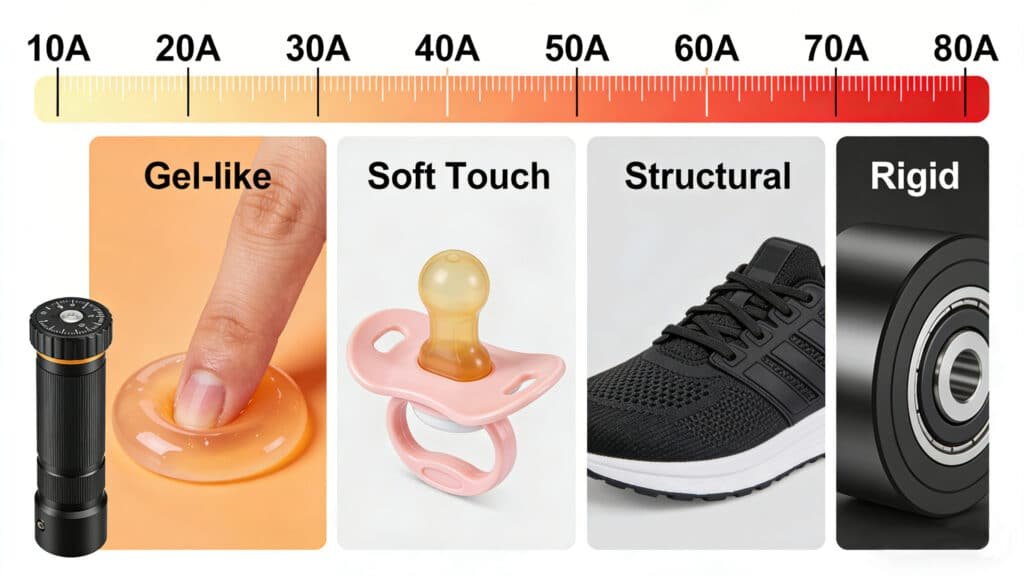
Shore hardness quantifies a material’s resistance to indentation by a standardized probe, providing an objective measure of softness or firmness.
The Shore A scale specifically applies to flexible elastomers like silicone rubber. A durometer instrument presses a spring-loaded indenter (a truncated cone for Shore A) into the material under controlled force, and the depth of penetration yields a reading from 0 (extremely soft) to 100 (extremely hard, approaching rigid plastics). Testing follows ASTM D2240 standards, with readings taken on flat samples at least 6 mm thick to avoid substrate influence. Conditions matter—temperature, sample preparation, and curing state can shift results by several points.
Here is a practical silicone Shore A chart with feel descriptions and everyday comparisons:
| Shore A Value | Feel Description | Example Comparison |
| 10A | Very soft | Gel-like silicone |
| 20A | Soft | Rubber band |
| 40A | Medium-soft | Tire tread (soft variant) |
| 60A | Medium-firm | Shoe sole |
| 80A | Hard | Hard rubber wheel |
These tactile analogies help engineers visualize performance during early design stages.
Typical Shore A Range for Silicone Products
Silicone compounds are typically produced in the 10A–80A range, balancing processability with functional performance. Very low hardness suits soft-touch or cushioning roles, while higher values provide structural stability and resistance to deformation.
Compound formulation—filler type, crosslink density, and curing method—strongly influences the achievable range. Liquid silicone rubber (LSR) often leans softer (down to 0–50A), while high-consistency rubber (HCR) supports firmer grades up to 80A or beyond in specialized compounds.
Common application-specific ranges include:
| Application Type | Typical Shore A | Reasoning |
| Baby products | 20A–40A | Ultra-soft for skin safety and gentle contact |
| Phone cases | 30A–50A | Balances drop protection with comfortable grip |
| Gaskets | 40A–70A | Ensures reliable compression without excessive extrusion |
| Industrial seals | 50A–80A | Withstands higher pressures and maintains shape under load |
| Keypads | 30A–60A | Provides tactile feedback with durable rebound |
For what Shore hardness for silicone gasket applications, 50A–70A is frequently optimal for most static or low-dynamic seals.
How Shore Hardness Affects Sealing Performance
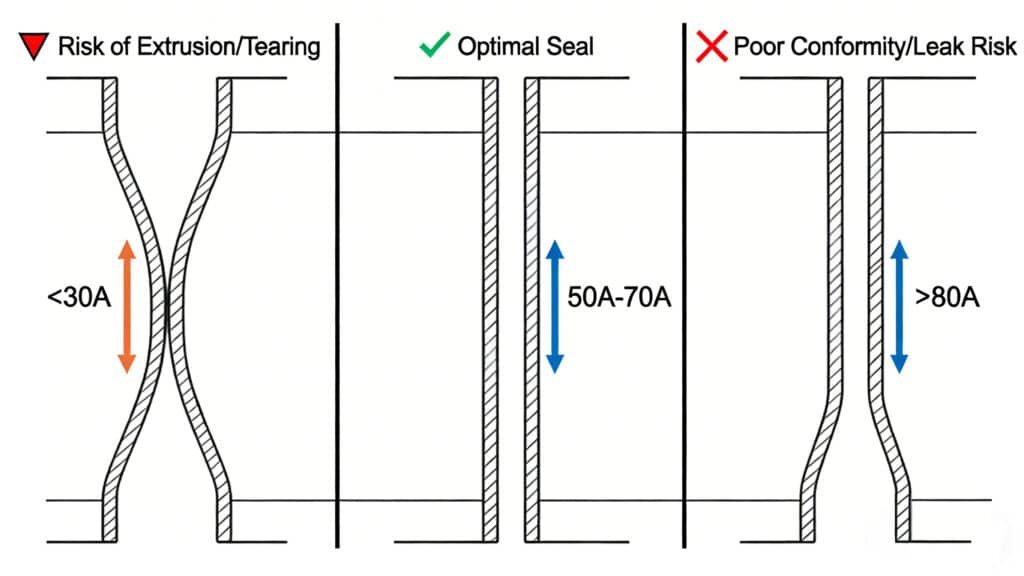
Hardness directly governs how well silicone conforms under compression to prevent leakage.
Softer grades generate lower contact pressure but excel at surface conformity on irregular mating faces. Higher hardness requires greater compression force for the same seal but resists extrusion in high-pressure environments. Over-compression of soft material risks tearing or permanent set, while under-compression of hard material leads to gaps.
A structured overview:
| Hardness Level | Sealing Behavior | Risk if Extreme |
| Too Soft | Excellent conformity, low force needed | Extrusion, tearing, or high compression set |
| Optimal Range | Balanced compression and recovery | Reliable long-term sealing |
| Too Hard | High pressure tolerance | Poor conformity, potential leakage on uneven surfaces |
Gasket thickness plays a critical role—thicker sections allow softer durometers without excessive deformation.
Hardness vs Mechanical Properties
Hardness correlates with several key mechanical properties, though trade-offs are inherent.
Lower Shore A values yield higher flexibility and elongation but lower tear and tensile strength. Higher values improve structural stability, abrasion resistance, and compression set performance but reduce stretch and user comfort.
A silicone hardness comparison table:
| Property | Lower Shore A (e.g., 20A–40A) | Higher Shore A (e.g., 60A–80A) |
| Flexibility | Higher | Lower |
| Tear Strength | Lower | Higher |
| Tensile Strength | Moderate to lower | Higher |
| Elongation at Break | Higher (up to 700–900%) | Lower (200–500%) |
| Compression Set | Potentially higher | Lower (better recovery) |
| Abrasion Resistance | Lower | Higher |
| Structural Stability | Lower | Higher |
| User Comfort | Higher | Lower |
These relationships stem from crosslink density: softer compounds have fewer links for chain mobility, while harder ones restrict movement for strength.
Shore Hardness and Tactile Experience in Consumer Products
In consumer-facing silicone components, hardness shapes perceived quality and functional interaction.
Soft-touch grades (30A–50A) deliver a premium, grippy feel in phone cases or kitchen utensils, enhancing anti-slip performance and comfort during prolonged use. Firmer durometers provide a more substantial, durable sensation but may feel less premium if over-applied. Long-term deformation risks rise with softer materials under repeated handling, potentially affecting brand perception—users associate excessive “give” with lower quality.
For wearables or handles, 40A–60A often strikes the ideal balance between grip and longevity.
Temperature and Hardness Stability
Silicone maintains relative hardness stability across wide temperatures, but shifts occur.
At low temperatures, many elastomers stiffen dramatically due to restricted molecular motion; silicone’s glass transition is around -115°C to -120°C, with noticeable stiffening only below -40°C to -60°C in standard grades. This “cold stiffening” increases effective durometer by 5–15 points in extreme cold.
At high temperatures, silicone softens slightly as chains gain mobility, though it resists degradation far better than organic rubbers up to 200°C+. Prolonged heat can cause gradual hardening via oxidation in open air or softening in sealed conditions.
Always evaluate operating temperature range—specify low-temperature compounds if exposure dips below -40°C, and factor in thermal cycling for seals or gaskets.
How to Choose the Right Shore A for Your Application
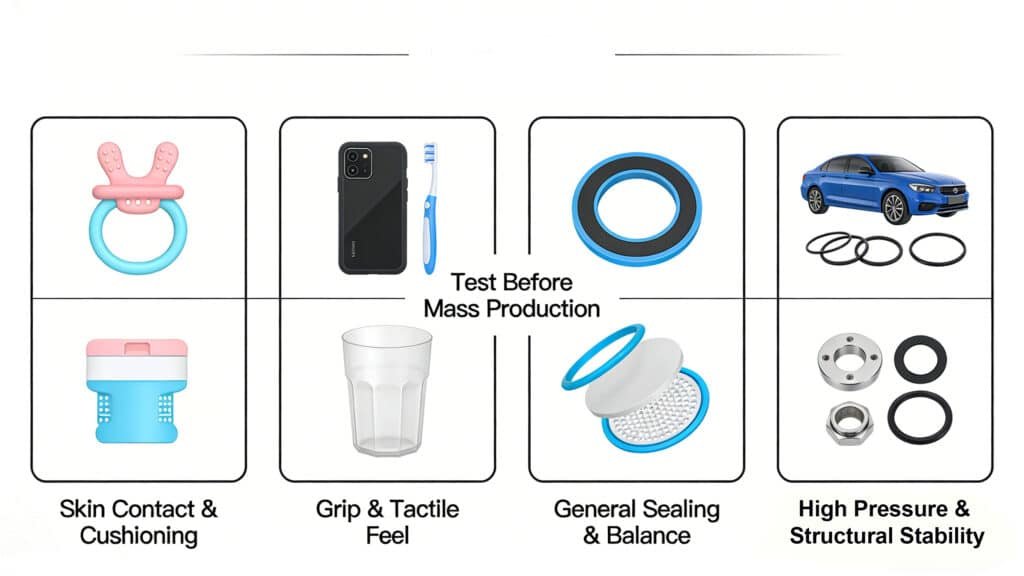
Silicone durometer selection requires systematic evaluation rather than guesswork.
A practical framework:
- Define mechanical function — Is it primarily sealing, cushioning, structural, or tactile?
- Evaluate sealing or structural role — Calculate required compression force and allowable set.
- Consider environmental exposure — Temperature extremes, chemicals, UV, or dynamic loads?
- Assess user interaction — Grip needs, perceived quality, or skin contact safety?
- Prototype and test — Validate with real-world compression, tear, and aging tests.
Testing remains essential—durometer alone doesn’t capture full behavior; iterate based on application-specific data.
Common Mistakes When Selecting Silicone Hardness
Engineers and procurement teams often overlook critical factors, leading to field failures.
- Choosing based on feel only — Prioritizing “soft” for comfort ignores load-bearing needs.
- Ignoring compression set — Soft grades may not recover after prolonged compression.
- Overlooking environmental temperature — Cold stiffening or heat softening alters performance.
- Not considering thickness — Thin sections amplify extrusion risks in soft material.
- Assuming higher hardness equals stronger performance — It improves some properties but sacrifices elongation and conformity.
Addressing these early prevents costly revisions.
Conclusion — Hardness Selection Is a Functional Engineering Decision
Shore A hardness defines how silicone behaves under compression, tension, and environmental stress. Selecting the correct durometer requires balancing flexibility, sealing performance, durability, and tactile expectations. The right hardness is determined by function—not by preference alone. Through structured evaluation and prototyping, engineers can avoid common pitfalls and achieve reliable, high-performing silicone components across applications.