
Meta Description: Compare silicone vs Viton (FKM) for heat resistance, chemical compatibility, compression set, and industrial sealing applications.
Excerpt: Silicone and Viton (FKM) are both used in high-performance sealing applications, but their resistance to heat and aggressive chemicals differs significantly. This guide compares silicone vs Viton in terms of temperature limits, chemical stability, compression set, and long-term durability to help engineers select the right elastomer for demanding industrial environments.
When comparing silicone vs Viton (FKM), the decision is primarily driven by temperature extremes and chemical compatibility — not simply by cost or general rubber classification.
Both silicone and Viton are high-performance elastomers widely used in industrial sealing, but they serve different roles based on their molecular structures. Viton (FKM), a fluorocarbon-based elastomer, excels in chemical resistance due to its strong carbon-fluorine bonds, making it the go-to choice for environments involving fuels, oils, and aggressive solvents. Silicone, built on a siloxane (Si-O-Si) backbone, offers superior flexibility across broad temperature ranges, particularly in extreme cold, along with excellent UV, ozone, and weather resistance.
A common misconception is that Viton is simply a “more expensive rubber” than silicone. In reality, its fluorinated chemistry provides unique stability against hydrocarbons and chemicals that would degrade most other elastomers. For aggressive chemical and fuel exposure at elevated temperatures, Viton (FKM) is typically superior. For extreme temperature flexibility and environmental stability, silicone may offer better performance.
What Is Silicone? Structure and Industrial Characteristics
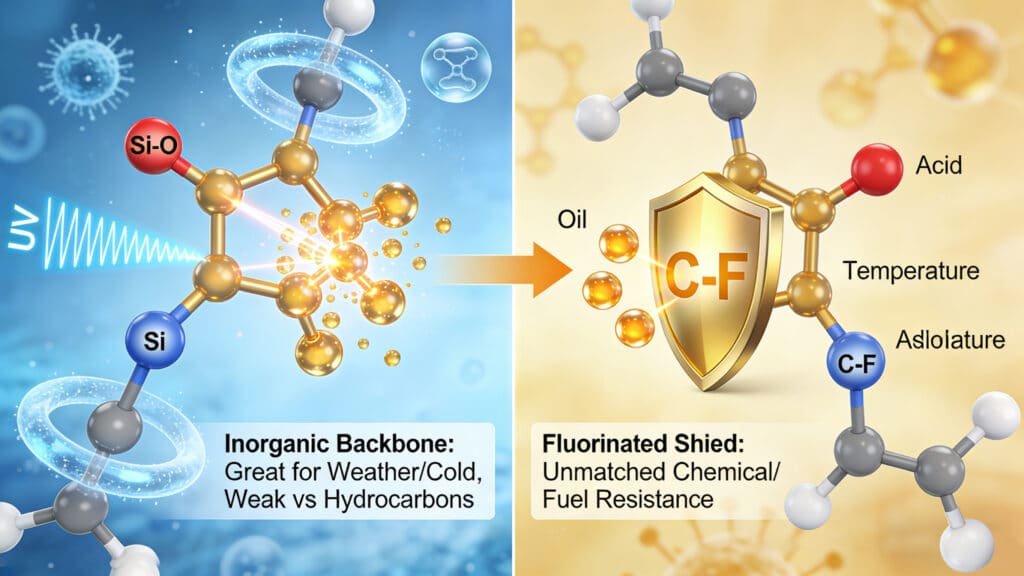
The reason why silicone rubber is so thermal stable and flexible is due to the inorganic backbone that is in siloxane polymer.
The structure confers silicone with incredible thermal degradation resistance and enables it to retain elasticity throughout a broad range of temperatures. The characteristic low-temperature performance of silicone is especially worthy of observation, as silicone is flexible at temperatures that are far lower than most organic rubbers become brittle. It is also excellent in relate to resistance to UV radiation, ozone and weathering and thus it can be used well to accommodate outdoor or any other exposed application.
Nonetheless, the chemical resistance of silicone is medium, it is resistant to fill in with some fluids but swells or vulcanizes upon exposure to oils, fuels, and most solvents.
The following is an overview of some of the important properties:
| Property | Silicone |
| Base Chemistry | Siloxane polymer |
| Temperature Range | -60°C to 230°C |
| Chemical Resistance | Moderate |
| UV/Ozone Resistance | Excellent |
| Compression Set | Good |
| Fuel Resistance | Limited |
Practically, silicone is commonly recommended in electronics enclosures, medical equipment, food grade seals and high temperature in stationary applications where the desire to flex instead of fierce fluid interaction is more important than the aggressive fluid contact.
What Is Viton (FKM)? Fluorocarbon Performance Explained
Viton (FKM) is a fluoride elastomer that has an excellent capability of withstanding heat and chemicals due to its excellent content of fluorine which is combined with strong carbon-fluorine bonds.
These bonds form unsurpassed resistance against failures through oxidation, swelling and degradation in adverse media. Viton is the material that prevails when it comes to long term exposure to petroleum-based fluids and is therefore a commonplace in fuel, chemical processing and oil and gas equipment.
Temperature working is also dependent on grade – standard compounds will serve continuously to approximately 200 230C with some specially designed compounds operating higher over brief times. If frequency flexibility is low (lower than silicone) then it is less than that of silicone but low-temp grade silicone weaknesses can be minimized.
| Property | Viton (FKM) |
| Base Chemistry | Fluorocarbon elastomer |
| Temperature Range | -20°C to 250°C (varies by grade) |
| Chemical Resistance | Excellent |
| Oil & Fuel Resistance | Excellent |
| UV Resistance | Good |
| Cost | High |
The fluorocarbon nature of viton ensures that it is applicable in harsh conditions that failure due to chemical attack will be disastrous.
Silicone vs Viton: Heat Resistance Comparison
The heat resistance is usually the initial aspect engineers consider when silicone and Viton are compared although it requires continuous or intermittent exposure, thermal cycling, and low-end flexibility.
Viton tends to operate at higher sustained temperatures, whereas silicone can be used at extreme temperatures, and is more pliant to thermal shocks.
| Temperature Factor | Silicone | Viton (FKM) |
| Max Continuous Temp | 230°C | 250°C |
| Short-Term Peak | High (up to 250–300°C) | Very High (up to 300°C+) |
| Low Temp Flexibility | Excellent (-60°C) | Moderate (-20°C) |
| Thermal Aging | Excellent | Excellent |
Viton usually has better service life in hot conditions where the chemical is exposed. Silicone does not go hard or crack under cryogenic or high-cycling conditions though including aerospace or outdoor industrial equipment.
Chemical Resistance: Where Viton Dominates
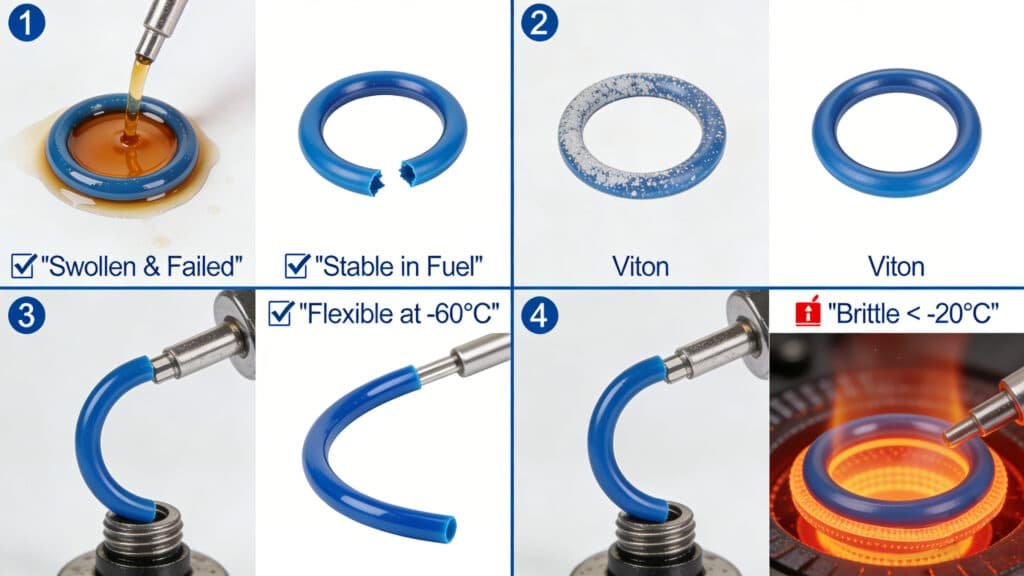
Many of the FKM vs silicone rubber decisions are influenced by chemical compatibility especially when it comes to process industries.
The fluorinated viton structure offers wide-spectrum resistance to hydrocarbons and, therefore, is much better with petroleum oils, fuels, solvents, and strong acids. Silicone is impervious to steam and to some ketones but vexingly expands in oils and fuels.
| Chemical Type | Silicone | Viton (FKM) |
| Engine Oil | Moderate | Excellent |
| Fuel | Limited | Excellent |
| Solvents | Limited | Excellent |
| Acids (Strong) | Limited | Good–Excellent |
| Steam | Good | Moderate |
In the chemical processing gasket or fuel system seals, Viton swells less and serves to maintain sealing integrity. Silicone can be used in situation where heat is steam-heavy or non-aggressive, but it is likely to fail when in contact with hydrocarbons.
Compression Set and Long-Term Sealing Performance
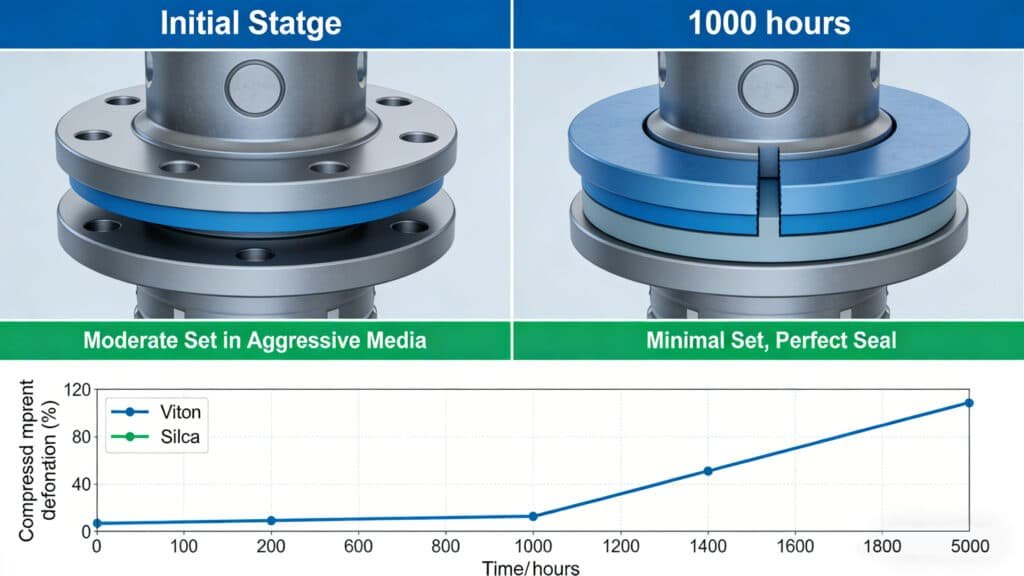
Compression set is used to determine the recovery of an elastomer following a period of compression – which is important in successful static and dynamic seals.
The two materials are both good, but Viton tends to compete successfully in high-temperature chemicals settings as a result of minimal swelling and more resistance to deterioration.
| Factor | Silicone | Viton (FKM) |
| High Temp Compression Set | Good | Very Good |
| Chemical-Induced Swelling | Moderate | Minimal |
| Long-Term Durability | Stable | Very Stable |
Practically, the lower limit of Viton in the presence of heat and chemicals is reflected in longer life of gaskets in pumps, valves, or compressors with aggressive media. Silicone is resistant to cleaner and temperature variable conditions.
Best Applications: When to Choose Silicone vs Viton
The choice of materials should coincide with the prevalent forces on them including either chemical exposure, temperature gradient or mechanical loads.
| Application | Recommended Material | Reason |
| Fuel system seals | Viton | Superior fuel resistance |
| Chemical processing gasket | Viton | Broad chemical stability |
| Electronics enclosure seal | Silicone | UV resistance + flexibility |
| High-temp engine area | Viton | Heat + fuel/oil compatibility |
| Medical device seal | Silicone | Biocompatibility + low-temp performance |
| Outdoor LED lighting | Silicone | Excellent UV/ozone stability |
Different grades of compounds differ, and engineers should always use reference to particular data sheets on compounds and perform application testing.
Cost Considerations and Performance Trade-Off
Compared to silicone, Viton is also much more expensive to process and extract in a raw state by a factor of 3 to 5.
Although initial investment is in favor of silicone, Viton is more durable in adverse environments, minimizing the risk in the long term, such as downtime, leakage, or even failure of equipment due to chemical attack. Silicone has become a great deal with no overspecification in low-chemical, temperature-centric applications.
Common Mistakes in High-Performance Seal Selection
One of the common problems of industrial designs is the incongruent choice of the elastomer. Key pitfalls include:
- The selection of silicone in fuel systems which swell rapidly and leak.
- Brittle failure in cold startups because the low-temperature flexibility requirements have been ignored.
- Ignoring entire chemical compatibility charts except on entry-level ratings.
- Making a comparison of maximum temperature ratings and not taking into account continuous exposure and cyclic exposure.
- Not doing the testing of prototypes with real operating fluids and pressures.
Comprehensive analysis of the entire operating spectrum avoids field failures, which are expensive.
Conclusion — Performance Requirements Define the Right Choice
The choice of elastomers Viton (FKM) in the field of fuel, oil, and aggressive exposure to chemicals at high temperatures remains very popular. It has unrivalled stability under these harsh conditions due to its fluorocarbon chemistry. Silicone on the other hand is very low-temperature flexible and environmental resistant and therefore can be used where a wide thermal control on weathering prevails.
It will be necessary to choose rightly, based on a close assessment of chemical exposure, temperature range and mechanical sealing requirements. Engineers are advised to consider application-dependent information, compatibility testing and in the real world performance rather than generalizations in their determination of silicone vs Viton (FKM).