
Meta Description (148 characters):
Compare silicone vs EPDM for seals based on temperature resistance, UV stability, chemical compatibility, compression set, and outdoor durability.
Excerpt (62 words):
Silicone and EPDM are widely used for seals and gaskets, but their performance differs significantly under heat, UV exposure, and chemical contact. This guide compares silicone vs EPDM in terms of temperature range, weather resistance, compression set, and chemical compatibility to help engineers select the right material for long-term sealing reliability.
Silicone vs EPDM for Seals: Temperature, Weathering, Chemical Resistance
When faced with the decision of silicone versus EPDM where one of the two choices is superior is not a question, but rather to find the correct match to the application requirements, both environmental and mechanical.
Both silicone and EPDM are among the most widely used elastomers in gaskets, o-rings, and in the case of a static seal, in the automotive, HVAC, outdoor equipment, and industrial machinery respectively. They are both effective under different environments: silicone is better performing when operating in extreme temperatures and temperature variation, whereas EPDM offers good weathering as well as cost-effective service in outdoor environment and wet conditions. Not all engineers know that EPDM and silicone cannot be used interchangeably when it comes to outdoor sealants. Practically, they have enough difference in temperature limits, compression set with time and the ability to act with fluids to create failures when used incompatible.
Silicone is usually better in high-temperature and wide-temperature-range systems. EPDM is likely to be adequate and dependable in outdoor weather and when sealing on a low budget.
What Is Silicone? Structure and Sealing Characteristics
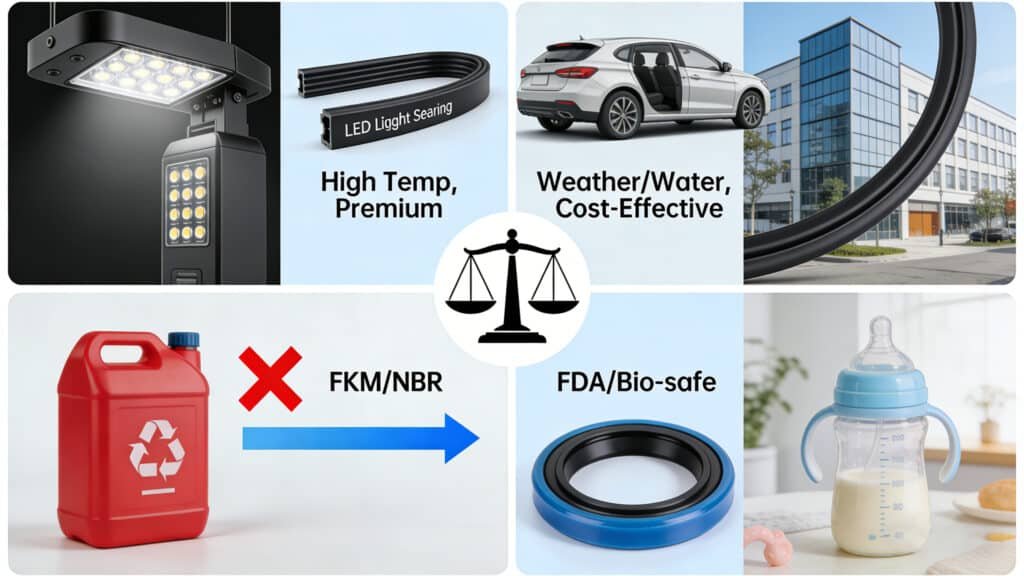
Silicone is most often used as an elastomer in the event the seals need to be flexible and capable of sealing force at extremely high or low temperatures.
The silicone rubber has a silicon-oxygen (siloxane) framework which inherently provides thermal stability and low temperature flexibility to the silicone rubber. This building also enables it to withstand thermal degradation much better as compared to most carbon-based rubbers. Silicone is a dependable material in sealing applications in both cold and high temperature environments with high UV / ozone protection that can avoid cracking of the seal at high temperatures. Even in heavily loaded high temperature situations compression set is good, but it is not the best in all modifications of a compound. Oil resistance remains within the moderate range, silicone can deal with non-polar fluids, but is subject to swelling when exposed to prolonged hydrocarbons.
| Property | Silicone |
| Base Chemistry | Siloxane (Si-O-Si) |
| Temperature Range | -60°C to 230°C |
| UV Resistance | Excellent |
| Ozone Resistance | Excellent |
| Compression Set | Good |
| Oil Resistance | Moderate |
| Cost | Higher |
What Is EPDM? Structure and Sealing Characteristics
EPDM also presents one of the most balanced profiles in case of cost-effective weather-exposed sealings.
EPDM (Ethylene Propylene Diene Monomer) is a vulcanizable, saturated, ethylene-propylene backbone synthetic rubber that is diene-modified. The result of this chemistry is an unparalleled fight against the chemical degradation of weathering and ozone, as well as UV degradation, which makes it a commodity in the automotive weather stripping, roofing membranes, and outdoor enclosures. EPDM performs well in water, steam, and polar fluid environments and it performs poorly in petroleum-based oils and fuels, where swelling and degradation is experienced very fast. Its temperature range is suitable to general ambient use as well as moderate temperature use, however at lower extremes it hardens faster than silicone.
| Property | EPDM |
| Base Chemistry | Ethylene-Propylene |
| Temperature Range | -40°C to 150°C |
| UV Resistance | Excellent |
| Ozone Resistance | Excellent |
| Steam Resistance | Excellent |
| Oil Resistance | Poor |
| Cost | Moderate |
EPDM is also predominant in the automotive door seals, window, and roofing gaskets since it has demonstrated a long-term performance in the exterior at a reduced cost of the material.
Silicone vs EPDM: Temperature Performance Comparison
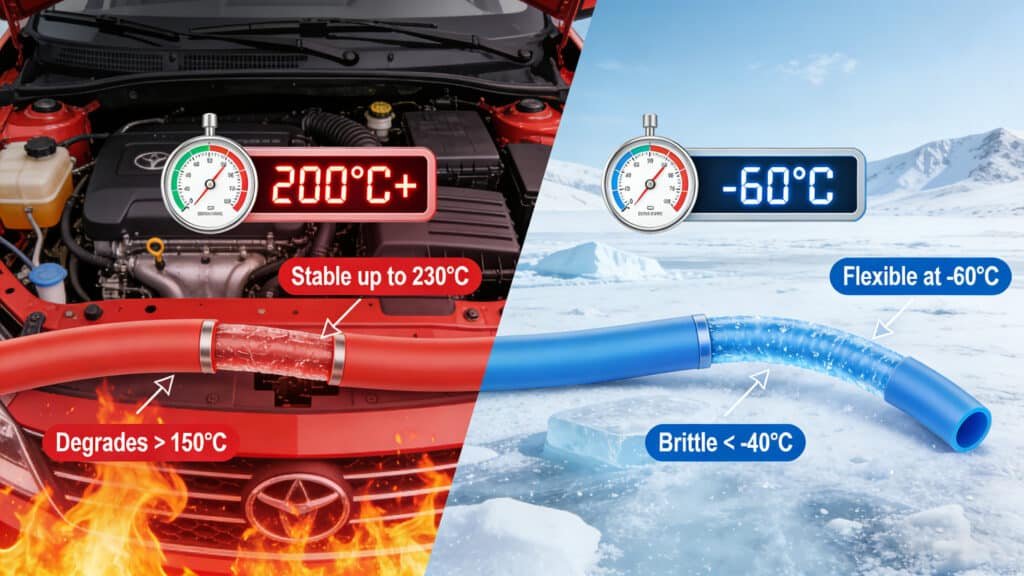
At temperatures that exceed the norms, silicone will always yield better results with regard to sealing reliability than EPDM.
Temperature is usually the most prevalent failure mode in seals. Silicone can withstand high temperatures well above 200 C and lose elasticity without severely limiting its performance, whereas silicone at higher temperatures, i.e. over 150 C starts to deteriorate. Silicone is non-brittle, becoming soft with as low as -60 C temperature, which prevents crack propagation and EPDM seals of cold-starting or cryogenic applications. Silicone is better in thermal cycling stability because its low data of glass transition reduces accumulation of stress.
| Temperature Factor | Silicone | EPDM |
| Max Continuous Temp | 200°C+ | 150°C |
| Low Temp Flexibility | Excellent (-60°C) | Good (-40°C) |
| Thermal Aging Stability | Excellent | Good |
| Extreme Heat Exposure | Superior | Moderate |
Silicone eliminates hardening and leakage problems in engine bay seals or high-heat industrial seals. Unless over-specified, EPDM is suitable enough in ambient outdoor or moderate HVAC.
Weathering and UV Resistance: Outdoor Sealing
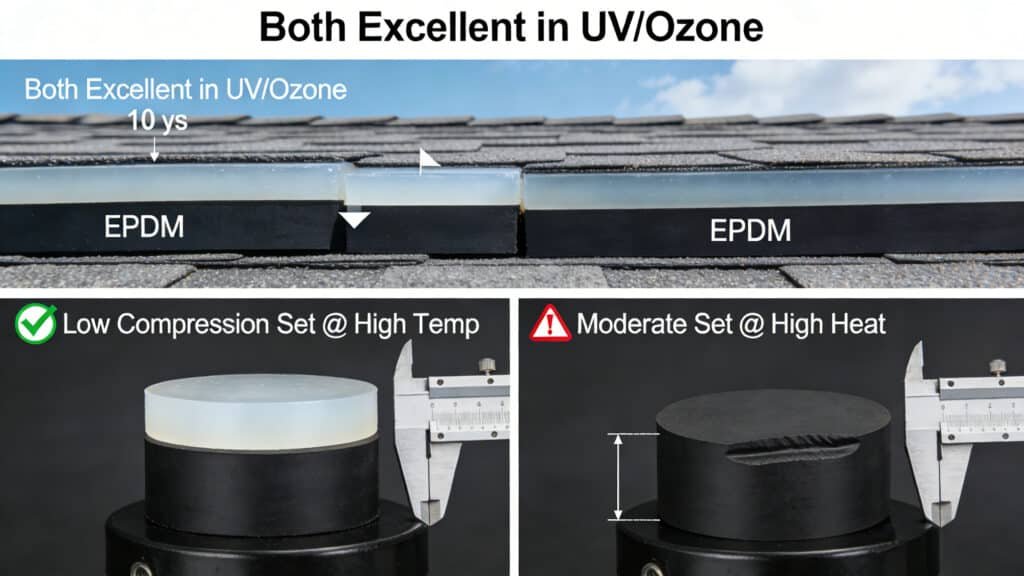
Selection Silicone and EPDM are two of the most suitable elastomers in prolonged outdoor applications, and in most applications there are only few distinctions.
Most of the rubbers are subjected to surface cracking by UV radiation, ozone, and also general weathering, this is countered by the saturated backbones in the two materials. The color stability is effective in a period of years, but in pure sunlight sometimes EPDM displays a little higher anti-loss because of the additives that are used in the formulation. Both have minimal surface degradation which contributes to 10-20+ years of life with exposed gaskets.
| Weather Factor | Silicone | EPDM |
| UV Resistance | Excellent | Excellent |
| Ozone Resistance | Excellent | Excellent |
| Outdoor Lifespan | Very long | Long |
| Surface Degradation | Minimal | Minimal |
In pure cost-per-year calculations, EPDM would be preferable to the outdoor gaskets, although silicone would be better under circumstances where there are temperature variations in addition to the exposure.
Chemical Compatibility and Fluid Exposure
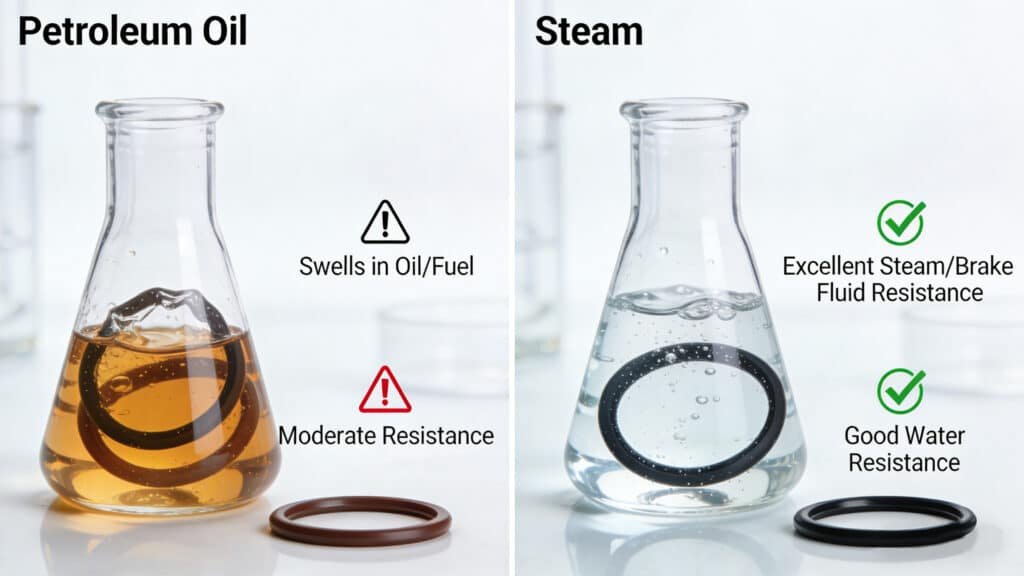
Both silicone and EPDM are not universally good in chemical environments- what is chosen depends upon the type of fluid that prevails.
They both are resistant to water, however, EPDM can better resist steam and hot water because of low swell. The degradation of EPDM is affected by petroleum oils and moderately by silicone (better with formulations). The two are compatible with coolants and mild acids but EPDM is more reliable with brake fluids and glycol. In the heavy oil exposure, try substitutes such as NBR or FKM.
| Chemical Type | Silicone | EPDM |
| Water | Excellent | Excellent |
| Steam | Good | Excellent |
| Petroleum Oil | Moderate | Poor |
| Coolant | Good | Excellent |
| Acids (Mild) | Good | Good |
Compression Set and Long-Term Sealing Reliability
Compression set is a direct indication of a seal maintaining contact force during time – particularly when a seal is under constant load and is under heat.
Compression set is a measure of the irreversible compression deformation. Silicone tends to recover better at high temperatures thus maintaining sealing integrity in non-dynamic applications. EPDM has satisfactory performance in most applications but has set increase in high heat conditions.
| Factor | Silicone | EPDM |
| Compression Set at High Temp | Good | Moderate |
| Recovery After Load | Stable | Good |
| Long-Term Static Seal | Reliable | Reliable |
In actual sense, bad compression set causes leakages even after years of service- silicone eliminates such cases in thermal intensive conditions.
Best Applications: When to Choose Silicone vs EPDM
The right choice emerges from aligning material strengths with application specifics.
| Application | Recommended Material | Reason |
| High-temp engine seal | Silicone | Superior heat resistance |
| Outdoor door gasket | EPDM | Weather durability and cost |
| HVAC sealing | EPDM | Steam & water resistance |
| LED lighting seal | Silicone | Heat + UV stability |
| Industrial enclosure gasket | EPDM or Silicone | Depends on temp and exposure |
Consider the overall circumstances of operation at the same time temperature extremes tend to shift to the side of silicone, whereas uniform outdoor service would be better served with EPDM.
Cost Considerations and Lifecycle Evaluation
First part material cost hardly ever tells the entire tale get concerned with overall life cycle performance.
Silicone is priced more in the market as a raw material, though its resistance to prolonged exposure to extreme situations can lessen the replacement rate and service interruption. EPDM exhibits great value in normal weathering work. Compliance (e.g., FDA with food contact) and maintenance When determining the actual ownership cost, factor in compliance (e.g., FDA with food contact).
Common Mistakes in Material Selection for Seals
Small variations which cause premature failures are often ignored by engineers.
- Disregard of temperature spikes that exceed nominal levels.
- Ignoring compression set data on actual operating temperatures.
- In the case of confusion of water resistance and oil resistance.
- Selecting on recommendation of suppliers without trying.
- The failure to test performance in realistic conditions (thermal cycling, fluids, load).
Conclusion — Matching Material to Environment Is the Key
Silicone together with EPDM are both good in regards to weather resistance but silicone wins in the extreme temperature conditions when EPDM offers reliable and affordable sealing in system exposed to the outdoors and water. The right option is based on thermal requirements, exposure to fluid, and future sealing prospects. Engineers can obtain leak-free and long-lasting performance at reasonable cost by focusing on application specific data as opposed to drawing generalizations.