
Meta Description (148 characters):
Compare silicone vs TPE for consumer products based on durability, safety, flexibility, aging resistance, and cost to choose the right material.
Excerpt (62 words):
Silicone and TPE are widely used in consumer products, but their performance differs in durability, safety compliance, aging resistance, and long-term stability. This guide compares silicone vs TPE to help brands and engineers choose the right material for baby products, electronics accessories, kitchenware, and more.
Silicone vs TPE: Which Is Better for Consumer Products?
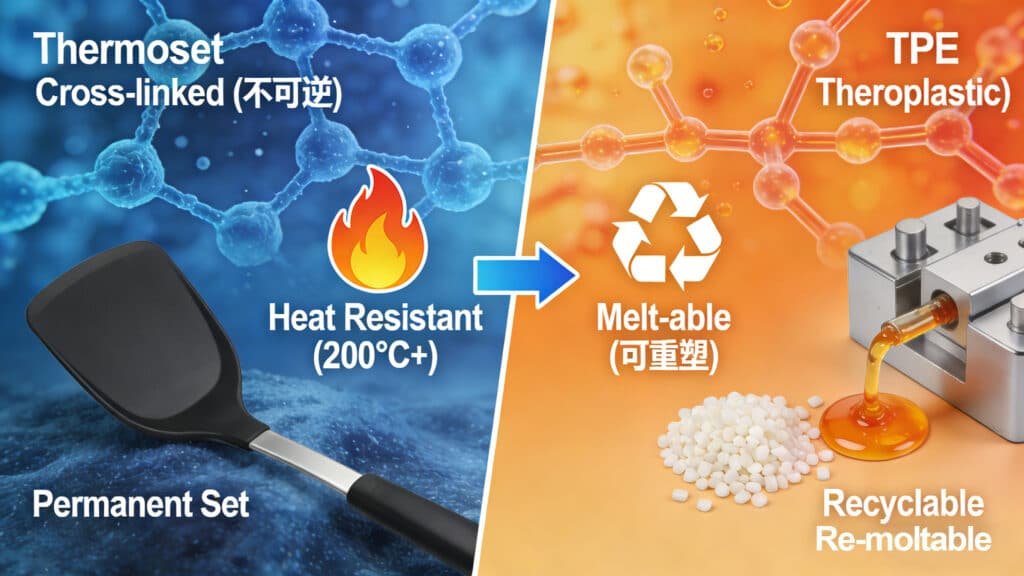
The decision on whether to use silicone or TPE in consumer products is not merely a matter of softness or price, but rather, one of durability, compliance safety, long term performance after the aging effect, and brand positioning.
Silicone and TPE are both elastic materials and are commonly employed in the manufacture of consumer products, including phone covers and kitchen ware and baby products. Nevertheless, they are highly differentiated in their chemical structure and stability of performance. Octane is a cross-linked thermoset elastomer and the molecules cannot melt, and TPE (thermoplastic elastomer) can be melted and reformed in its shape like plastic.
TPE is often erroneously considered by many brands as a cheaper and direct substitute of silicone. The silicone and TPE differ, in actual sense, when it comes to durability, aging behaviour and regulatory compliance pathways.
Silicone tends to be better than TPE in terms of application where long-term stability, high-temperature tolerance, and high positioning are required. TPE might be adequate in cases where the performance requirements are intermediate and the quantity of units per production is large and needs to be cost-sensitive. The decision must ensure that it applies the product lifecycle other than the initial cost of materials.
What Is Silicone? Structure and Consumer-Relevant Properties
Silicone is a thermoset elastomer which exhibits very high stability; thus it is suitable in the harsh consumer use.
The structure of silicone is silicon-oxygen bond chains which are cross linked over the course of curing to create a permanent network. It is a structure that gives the impeccable resistance against heat, UV light, ozone and environmental aging, and remelting is not possible any more. It is adaptable in a great variety of scope of temperatures and sustains characteristics even on years of use.
The relevant key properties when using consumer products are:
| Property | Silicone |
| Material Type | Thermoset elastomer |
| Heat Resistance | Up to 200°C+ (some grades higher) |
| UV Resistance | Excellent |
| Aging Stability | Excellent |
| Recyclability | Limited (cannot remelt) |
| Food/Baby Compliance | Easy (FDA/LFGB possible) |
| Cost | Higher |
Such characteristics ensure the efficacy of silica in things that get exposed to heat, washing, or prolonged usage.
What Is TPE? Structure and Key Characteristics
TPE has numerous performance formulations that are employed as a versatile thermoplastic elastomer but has cost benefits.
TPE incorporates plastic and rubber based properties, thus, it can be melted and reformed several times. Some of the popular ones are styrenic block copolymer (SBC), thermoplastic olefins, and so on. This thermoplastic property facilitates easy processing but decreases extreme-condition stability.
Formulations do have effects, some TPEs do better in abrasion or flexibility, but they are all less effective than silicone in heat or aging.
| Property | TPE |
| Material Type | Thermoplastic elastomer |
| Heat Resistance | 70–120°C (typical) |
| UV Resistance | Moderate |
| Aging Stability | Moderate |
| Recyclability | Yes (can remelt) |
| Cost | Lower than silicone |
TPE is applicable in processes that have emphasis on speed and recyclability of scrap loops.
Silicone vs TPE: Side-by-Side Performance Comparison
Compared to silicone vs TPE, silicone normally has a better long-term stability, whereas TPE has a high level of processing efficiency and cost.
| Performance Factor | Silicone | TPE |
| Heat Resistance | Excellent | Moderate |
| Cold Flexibility | Excellent | Good |
| UV Stability | Excellent | Moderate |
| Long-Term Aging | Very stable | May harden or degrade |
| Oil Resistance | Moderate | Varies |
| Food-Grade Potential | Strong | Possible but more limited |
| Surface Feel | Smooth, premium | Soft, slightly plastic-like |
| Manufacturing Method | Compression/LSR molding | Injection molding |
| Cost | Higher | Lower |
Heat resistance is prominent: silicone can withstand temperatures as high as 200 o C or above and still not become deteriorated; thus, suited in kitchenware or other products, which are close to heating devices. TPE can easily be softened or deformed beyond 120 o C.
Silicone is also an aging and UV-resistant material that is easy to crack or yellow in the outside. TPE can stiffen, stick or lose its elasticity as time progresses particularly without additives.
In the case of TPE vs silicone, compressibility and recovery ability after repetitive stress has been experienced under weight, the cross-linked structure of silicone would offer superior compression set and recovery.
Pros and Cons of Silicone for Consumer Products
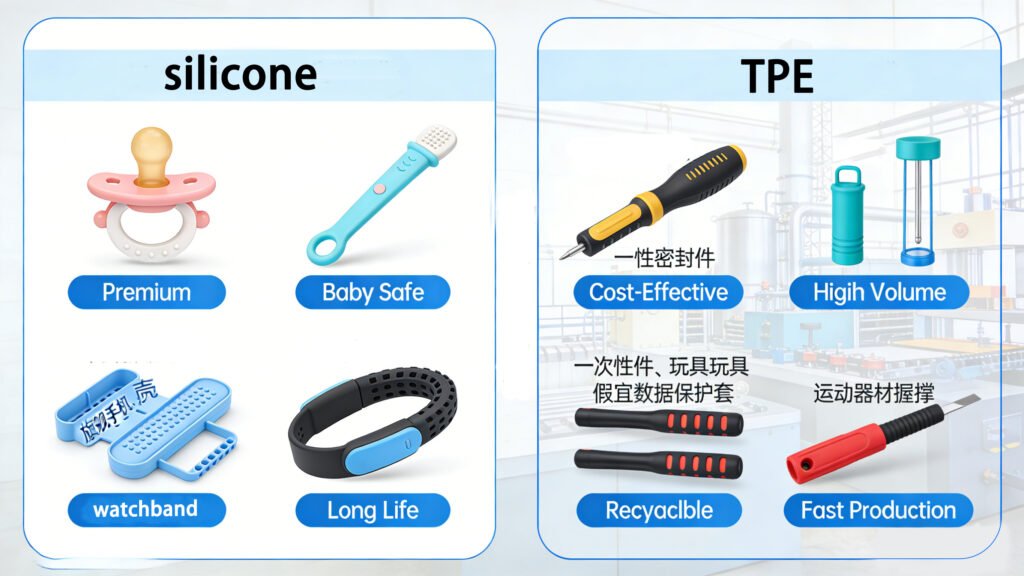
Silicone still continues to be sought after in the case of high-end consumer products due to its exceptional environmentally-locking stability and safety profile.
Examples of the advantages are that it is better than other materials in terms of heat resistance when used as baking utensils, or other items that will be sterilizable in the long term, its effectiveness in high product life perceptions since it can be used without replacement, the characteristic of excellent tactile feel which improves perceived quality as well as excellent color retention, and its suitability during use as a baby and kitchen product due to the biocompatibility present.
Demerits revolve around increased material cost, extended production loop after curing as well as degradation due to lack of specific processes that can be recycled.
Pros and Cons of TPE for Consumer Products
TPE has a sensible advantage in high volume, low cost manufacturing and offers decent flexibility.
The benefits include reduced material and processing expenses, increased injection molding speed and reduced turnaround speed, simplicity of color change and overmolding, and the ability to recycle the manufacturing scrap and minimized wastage.
It has some negative effects of reduced heat tolerance that could cause deformation, the long-term effects may also cause hardening/stickiness and shortened life on outdoor use or high-stress applications, and performance is influenced by the formulation used.
Best Applications: When to Choose Silicone vs TPE
Which sealant to use silicone or TPE is the right one to use, in accordance with the performance priorities, in accordance with the environmental exposure, the market position.
| Application | Recommended Material | Reason |
| Baby teething toys | Silicone | Safety + durability + biocompatibility |
| Phone cases | Silicone or TPE | Depends on price positioning (premium vs budget) |
| Kitchen baking mats | Silicone | Heat resistance |
| Soft grips (tools/toys) | TPE | Cost efficiency + flexibility |
| Medical-grade products | Silicone | Biocompatibility + sterilization |
| Sports handles | TPE | Shock absorption + cost |
In the case of TPE vs silicone in infant formula, the compliance (FDA, LFGB) of silicone and its inertness is safer in the case of extended contact with the mouth. The choice of silicone or TPE phone cases is usually based on the option of high tactile feel (silicone) or low cost (TPE).
Manufacturing Considerations: Injection vs Compression
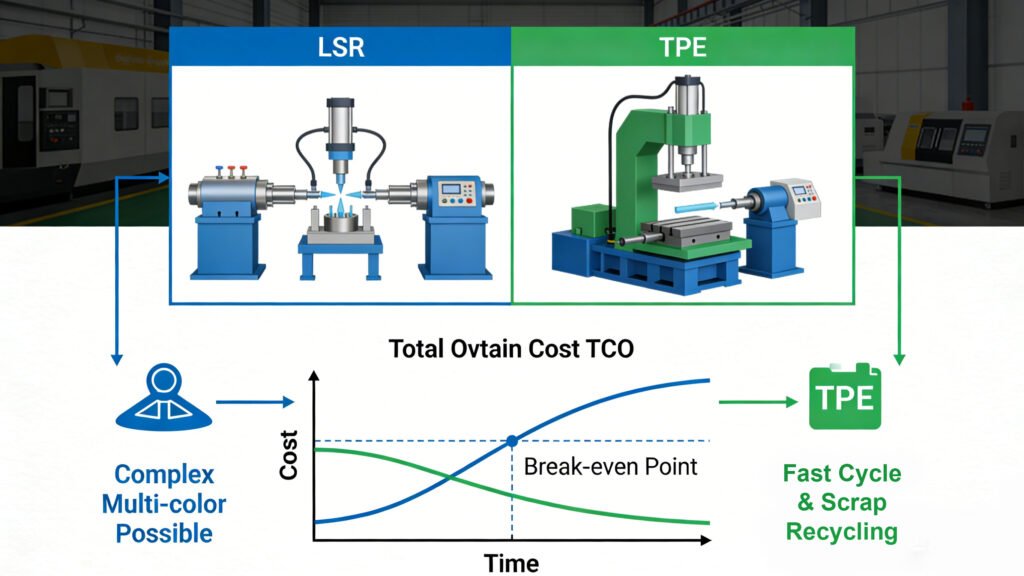
In terms of production, TPE and silicone will require alternative strategies and it will have an effect on tooling, cycle time, and complexity.
TPE is injected by conventional injection means: pellets are melted and then injected into cold moulds, and solidify in a short time – difficult to scale up by large quantities, but cheap in terms of tools.
Silicone: Compression is also used in solid techniques or liquid silicone rubber (LSR) injection: liquid blends, injected into heated molds to cross-link/hhare. This involves a very narrow tolerance to temperature, and venting with vacuums and increased cycles but allows complex multi-color integrated molding (patented strength in our processes).
With regard to scrap recovery, TPE (regrind possible) has a greater advantage over silicone scrap. LSR process of silicone has benefits in more complex, multi-color consumer components although start-up costs are increased.
Long-Term Brand Positioning: Premium vs Mass Market
The type of material has an impact on the way consumers can view the quality and the durability of the product.
Silicone can be used to indicate high-end status via the soft, wear-resistant texture, color consistency, and durability, which is synonymous with high-involvement brands (e.g., kitchenware or baby products). The good feedback is the product of regular use in the real-life.
TPE is appropriate to mass-market strategies with cost effectiveness that enables competitive pricing and short iterations, typical in the everyday use of accessories.
Product longevity has a direct impact on returns, reviews, and repeat purchases the brands that establish long-term loyalty should use silicone.
Common Mistakes Brands Make When Choosing Between Silicone and TPE
Lots of sourcing teams do not take into consideration some critical aspects, which contribute to their performance or increased lifecycle costs.
- Only analogy of raw material price and nothing concerning the production process and its durability.
- Disregard of requirements of heat exposure in end-use (e.g. dishwasher-safe claims).
- Failure to test against UV, heat or chemicals aging.
- Failure to realize the life of the product as a product.
- The neglecting compliance testing of food/baby contact.
Conclusion — The Right Choice Depends on Performance Priorities
The silicone vs TPE debate does not have a universal winner, as either is good at particular occasions.
Silicone has a better stability, heat/UV resistance, and long-term performance and is related to the choice of safety-critical or superior consumer products. TPE is flexible in cost, processing and recycling of volume oriented applications.
The right decision will be based on the performance requirements of the product, positioning to the target market, the expected lifecycle of the product, as well as the actual demands of the product in the real world environment-not just material perception. By testing the prototypes in real life conditions, one is guaranteed of optimum results in terms of durability, compliance and brand value.