
Meta Description (148 characters):
Compare platinum-cured vs peroxide-cured silicone in terms of purity, compliance, mechanical properties, odor, cost, and best applications for food-grade, medical, and industrial use.
Excerpt (62 words):
Platinum-cured and peroxide-cured silicone differ in crosslinking chemistry, affecting purity, odor, compliance, and long-term performance. This guide explains the technical differences, mechanical properties, food-grade implications, and ideal use cases to help product developers choose the right curing process for their application.
Platinum-Cured vs Peroxide-Cured Silicone: Differences & Use Cases
The distinction between platinum-cured and peroxide-cured silicone is in the crosslinking chemistry – and that difference directly influences purity, compliance as well as long-term performance. The two techniques yield crosslinked silicone elastomers that can be used in the manufacture of many types of molded and extruded products, although in platinum curing, the primary catalyst is a platinum catalyst that utilizes the addition-cure chemistry, and, in peroxide curing, the primary catalyst is organic peroxides which initiate a free-radical crosslinking mechanism. This decision has impacts on volatile residues and sensory attributes to regulatory approval routes and the production economics. There is no universal best one; the correct one will be determined by the nature of the requirements of compliance, restrictions of the cost, and the environment in which the application will be utilized.
Silicone with platinum cure is more purer and more food and medical compliant whereas silicone with peroxide cure is more economical and has high performance of silicone in general industries.
How Silicone Curing Works: A Basic Overview
Raw silicone rubber Raw silicone rubber is a polymer of high molecular weight with a limited elasticity; it does not start acting like a rubber until the crosslinking forms a stable three-dimensional network.
The process of crosslinking joins polymer chains where the resultant becomes an elastic solid and it can undergo repeated deformation and recovery. The reaction pathway, byproducts and ultimate properties depend on the curing method, addition or free-radical. The rate and homogeneity of such a network are controlled by catalysts or initiators and the greater part of industrial processes are activated by heat.
| Stage | Description |
| Base Polymer | Siloxane chains (polydimethylsiloxane backbone) |
| Crosslinking Agent | Platinum complex or organic peroxide |
| Catalyst/Mechanism | Platinum (addition) or free-radical (peroxide) |
| Heat Activation | Required for curing (typically 120–200°C) |
| Final Result | Elastic silicone rubber |
These fundamentals serve to explain why curing decision is important in more than the basic elasticity.
What Is Platinum-Cured Silicone?
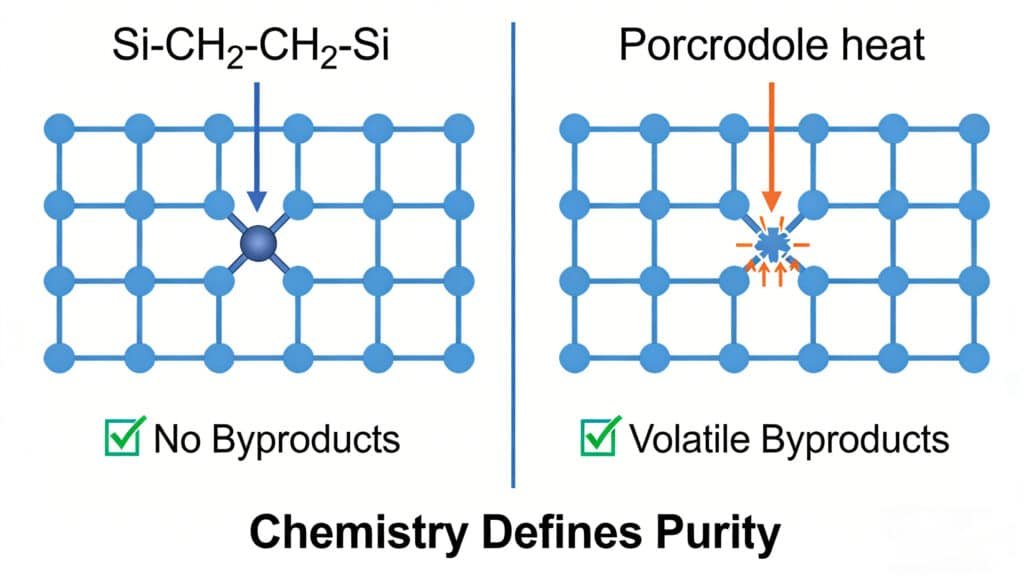
Addition cure silicone is the same as platinum-cured silicone, an addition catalyst used to enable a byproduct-free crosslinking reaction between vinyl-functional polymers and silicon hydride crosslinkers.
Minimum residues obtained in this process lead to no odor, extreme transparency and very low extractables, which make this process of choice when dealing with sensitive applications. There is no additional care after curing and this makes manufacturing easily accessible and also consumes less energy.
| Property | Platinum-Cured Silicone |
| Curing Method | Addition cure |
| Byproducts | Minimal |
| Odor | Neutral |
| Transparency | High |
| Compliance Ease | High |
| Cost | Higher |
Platinum-cured silicone is very effective in practice in baby products, kitchenware and medical components, where purity is essential.
What Is Peroxide-Cured Silicone?
Peroxide-cured silicone The initiator of the crosslinking is based on organic peroxide initiators that form free radicals which propagate the crosslinking process by a chain reaction.
The older and established process may result in volatile byproducts (like organic acids), which when not controlled can result in slight odor, surface bloating, and discoloration. Secondary heat treatment in a ventilated oven at a lower temperature is commonly required to drive off residues and stabilize properties: this is called post-curing.
| Property | Peroxide-Cured Silicone |
| Curing Method | Free-radical |
| Byproducts | Possible residues |
| Odor | Slight odor possible |
| Transparency | Moderate |
| Compliance | Possible with testing |
| Cost | Lower |
The volatiles produced with post-curing are highly minimized and therefore silicone cured with peroxide can be used in numerous regulated applications when it is well processed.
Platinum vs Peroxide: Side-by-Side Technical Comparison
The chemical crosslinking structure generate quantifiable variations in significant performance parameters, yet base silicone-based recipes contribute too.
| Performance Factor | Platinum-Cured | Peroxide-Cured |
| Purity | Very high | Moderate |
| Odor | Neutral | Slight odor possible |
| Transparency | High | Medium |
| FDA/LFGB Compliance | Easier | Possible with testing |
| Mechanical Strength | Good | Good |
| Tear Strength | Comparable to slightly better | Comparable |
| Cost | Higher | Lower |
| Post-Cure Required | Usually no | Often yes |
The mechanical differences are in most cases subtle even though purity and regulatory benefits are inclined towards platinum when it comes to critical applications.
Impact on Food-Grade and Medical Compliance
Migration, volatiles, and sensory impact are the determinants of food-grade and medical compliance and these are places where curing chemistry plays a major role.
The clean reaction of platinum curing reduces the extractables and the leachables and makes the migration testing (e.g., FDA 21 CFR 177.2600 or EU Reg. 10/2011) and the sensory testing of LFGB simpler. Peroxide puts demand on intensely post-cure and third-party analysis to comply with identical 50 percent thresholds since residual volatiles is capable of impacting odor/taste analysis or stability over time.
| Compliance Factor | Platinum | Peroxide |
| FDA Compliance | Common | Possible |
| LFGB | Easier | Requires strict testing |
| Medical Grade | Common | Less common |
| Odor Testing | Passes easily | Requires control |
Adequate documentation, such as test reports by batches, is necessary despite the method of curing.
Mechanical and Physical Property Differences
Although the technique of curing affects crosslinking density and chain mobility, it does not have a fundamental change in base silicone functioning when the formulations are similar.
Both systems attain comparable hardness levels (usually 20 80 Shore A), good elastic recovery and high tear strength. Variants cured with platinum tend to exhibit a little higher elongation and tensile strength caused by more evenly-spaced crosslinks, whereas those cured with peroxides may have slightly better compression set in higher temperature sealing processes. Both have high heat aging resistance, but peroxide systems might need optimization with post-cure to reduce the chances of reversion during extended exposure.
Best Applications: When to Choose Each Curing Method
The choice of the curing method begins with the matching of the purity requirements with budget costs and the end-use requirements to the environment.
| Application | Recommended Cure | Reason |
| Baby products | Platinum | Purity and low extractables |
| Baking mats | Platinum | Odor-free, food contact safety |
| Medical tubing | Platinum | Biocompatibility, transparency |
| Industrial gaskets | Peroxide | Cost efficiency, durable sealing |
| Automotive components | Peroxide | Economical + reliable performance |
| General consumer goods | Depends | Budget vs compliance balance |
Platinum minimizes risk in products where there is direct food or body contact; when the parts used in the industry are cost sensitive, peroxide may also provide the same solution.
Cost and Manufacturing Considerations
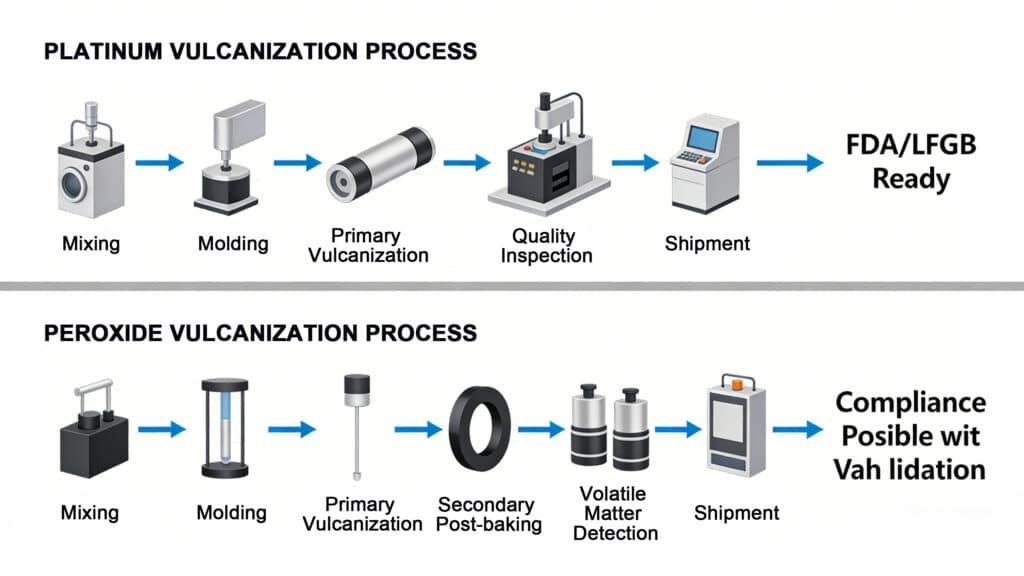
The platinum catalysts are higher in price and more prone to contamination, which means they are more costly to obtain and cleaner production sites have to be used.
Peroxide systems have lower catalyst prices and are more resistant to variation in the process, but after curing, additional oven time and energy and handling are required. The injection co-molding (particularly LSR) of platinum is more likely to be faster in production cycles, whereas peroxide would be better compression or extrusion and use post-bake. Platinum used as an inhibitor can increasing the scrap rate, however, multi-color molding, widely used in the consumer products, can be advantageous due to the clean reaction of platinum and its compatibility with our patented multi-color integrated molding process.
Common Misunderstandings About Silicone Curing
- Always Platinum-cured – Not all food grade Not all base formulation, pigments and testing still determine compliance.
- Incidentally, peroxide-cured cannot be food-safe – This can be brought to standards post-curing and validation.
- Mechanical strength is radically distinct -Differences are usually small; formulation dominates.
- Curing method- Color- The cure system is not pigments but color.
- The other process will entirely replace the former one- Both however will be applicable depending on application economics and needs.
Conclusion — Curing Method Should Match Application Requirements
The key distinction between the platinum-cured and the peroxide-cured silicone lies in the crossover chemistry: addition cure and free-radical. Silicone with a platinum cure has better purity and regulatory properties, thus it is best used in food-contact and medical applications where one cannot compromise on low extractables and neutral sensory characteristics of food. Silicone with peroxide cured is stable and costs less when used in industrial as well as general products, particularly when post-cured to maintain residues.
Finally, the right decision is taken according to the compliance requirements, performance requirements, and budget. Migration data, mechanical testing, and total landed cost should be considered by engineers and sourcing groups as opposed to adapting to a single way of doing things based on guesses. This application base strategy guarantees success in the long run in custom manufacturing.