
Meta Description (148 characters):
Learn what food-grade silicone means, how FDA and LFGB standards apply, and how to distinguish compliant silicone from marketing claims. Essential guide for brands ensuring safe food-contact materials.
Excerpt (68 words):
Food-grade silicone is widely used in kitchenware and baby products, but many brands misunderstand what the term actually means. This guide explains FDA and LFGB standards, platinum vs peroxide curing, safety testing requirements, and common myths about food-grade silicone to help product developers make informed material decisions.
Food-Grade Silicone Explained: What It Is and What It’s Not
Food-grade silicone is no marketing lingo, it is a compliance-based label with compliance based testing standards, formulation purity and controlled manufacturing processes.
It is mistakenly believed that food-grade silicone is a special type of material that has special characteristics such as excessive softness or brilliant colour. It in fact is a regulatory term: any silicone has the potential to become food-grade, which is the level of its formulation, additives, curing procedure, and manufacturing controls that will satisfy certain food contact safety standards. Migration testing (measuring the amount of substances transferred into food, how little is transferred to food) and strict concentrations on extractables, heavy metals and other possible migrants demonstrate compliance.
Regulatory approval and migration testing characterizes food-grade silicone – not color, softness, or supplier assurances. The major criteria are the 21 CFR 177.2600 of the U.S. FDA on repeated-use rubber articles and the LFGB (widely used as a benchmark in Europe), which demand low rate of substance transfer, sensory indifference, and controlled production.
The knowledge about these differences assists companies to avoid compliance risks particularly when sourcing in Asia where documentation quality is different.
What Is Silicone? Basic Material Background
Silicone is an unnatural rubber or plastic that is a synthetic elastomer, useful in extreme conditions, and is very stable.
Silicone (polysiloxane) is essentially composed of alternating units of silicon and oxygen with organic side chains (typically methyl) on to the silicon. This architecture provides such benefits as: broad temperature range, flexibility, and degradation resistance.
These properties make silicone find use in all sorts of industries medical tubing, automotive seals, industrial gaskets among others. Nevertheless, not all silicone is food-safe by default; the safety of any silicone base lies with the formulation (base polymer + additives + curing agents) and hygiene of production.
The following is a summary of property:
| Property | General Silicone |
| Heat Resistance | Up to 200–230°C (some grades higher) |
| Flexibility | Excellent |
| UV Resistance | Excellent |
| Chemical Stability | Good |
| Food Safe by Default? | No (depends on formulation, additives, curing, and testing) |
The most important thing is purity: industrial silicone usually contains fillers, colourants or materials used during the curing of silicone, which are not suitable to touch food.
What Makes Silicone “Food-Grade”?
The term food-grade silicone achieves its name due to highly stringent regulatory adherence directed towards any undesired transfer into food.
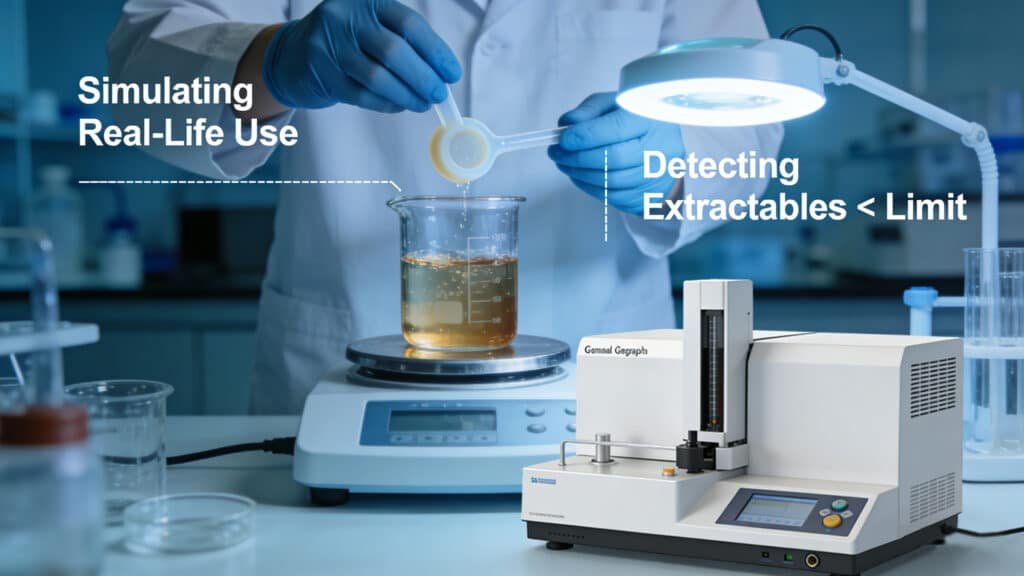
The classification depends upon:
- Legislations – mostly FDA 21 CFR 177.2600 (U.S.) and LFGB (Germany / E.U. standard)
- Migration testing – in general and limits concerning substances that transfer to food simulants (water, alcohol, fatty media) specifically.
- Extractables constraints -minimal amounts of soluble components following exposure to test conditions
- The censoring of heavy metal – stringent regulations on lead, cadmium, mercury, and so on.
- Odor and taste neutrality No unpleasant odors or flavor added to food.
- Control of the manufacturing environment – clean production, following GMP, no cross-contamination.
Paperwork is not negotiable: suppliers should not submit certificates but must submit up to date test reports of accredited labs.
Key requirements at a glance:
| Requirement | Description |
| FDA 21 CFR 177.2600 | U.S. food contact compliance for repeated use |
| LFGB | German/EU food safety standard (often stricter) |
| Migration Testing | Limits on substance transfer to food simulants |
| Platinum Curing | Cleaner crosslinking process (preferred for purity) |
| No Harmful Fillers | Controlled formulation, no banned additives |
Both standards require evidence of inertness of material used in the desired conditions of use.
Why Migration Limits Matter
Migration experiments are a simulation of real-life contact (temperature, time, food type). After much migration, there can be an exposure of the consumer to unintended chemicals.
FDA vs LFGB: What’s the Difference?
Both FDA and LFGB provide assurance of food-contact safety although LFGB is more stringent, and incorporates more of the requirements relating to sensory.
FDA (U.S.) is concerned with extractives in water and hexane simulants that are less than 21 CFR 177.2600 and that the materials do not affect food safety or quality. LFGB (powerful in EU) incorporates overall sensory (odor/tasting) assessment, reduced particular migration limits on specific volatiles and extensive contaminant screening (e.g., PAHs, VOCs).
In the case of brands that are aimed at high European markets, an LFGB compliance usually translates to increased material purity.
Comparison:
| Standard | Region | Strictness | Odor/Taste Testing | Market Perception |
| FDA | USA | Moderate | Limited | Common global baseline |
| LFGB | Germany/EU | Higher | Yes (sensory mandatory) | Premium positioning, stricter purity expectations |
To maximize the rewards in both markets, many manufacturers use LFGB as the approach; it usually meets the requirements of the FDA, but provides an additional safety measure.
Platinum-Cured vs Peroxide-Cured Silicone
Silicone that is platinum-cured tends to give cleaner, purer results that are suitable to food-contact usage, although both curing systems can be used to comply with acceptable formulation and testing.
The polymer chains are crosslinked to give the ultimate elastic material by curing.
- Platinum-cured (addition cure): It is used as a platinum catalyst; no volatile byproducts; minimal residues are formed, an increase in transparency and the odor is neutral; it is easy to follow the rigorous standards, such as LFGB.
- Peroxide-cured (free-radical cure): Organic peroxides are used; may leave byproducts (e.g., volatile acids) which need extensive post-curing; may produce a slight odor or reduced transparency.
Both may be induced to food-grade standards, though platinum-cured is intended to be used when there is need to meet high standards such as in applications of high demand, because of reduced chances of migration.
Comparison:
| Factor | Platinum-Cured | Peroxide-Cured |
| Residue | Minimal | Possible byproducts (post-cure reduces) |
| Odor | Neutral | Slight odor possible |
| Transparency | High | Moderate |
| Compliance Ease | Easier for LFGB | Possible but more testing often needed |
| Cost | Higher | Lower |
Platinum-cured is the leader of quality kitchen and baby items.
Common Myths About Food-Grade Silicone
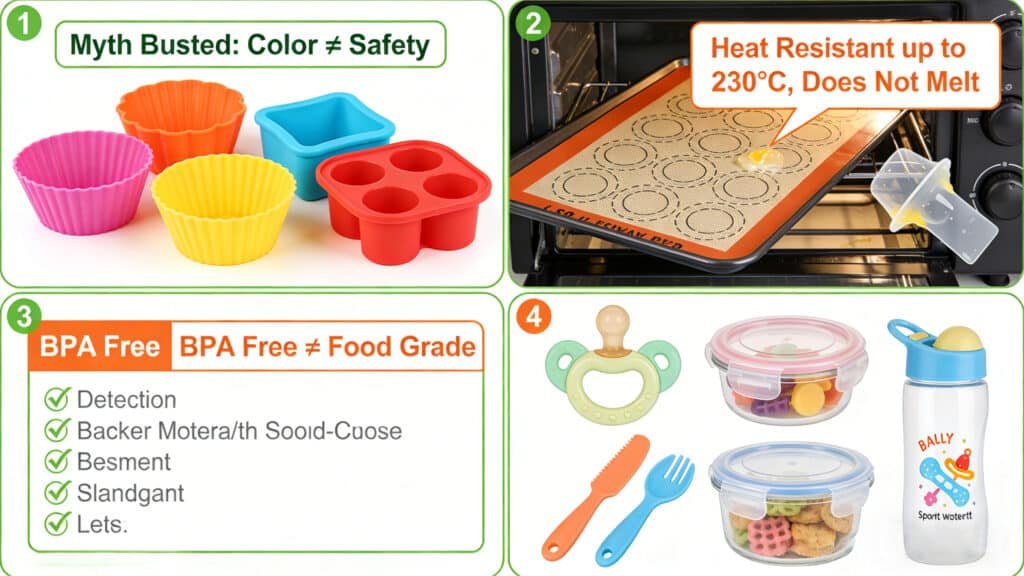
There are a number of myths in the industry – the following are the truths:
- Myth: Silicone is all food grade Fact: No, only silicone with passing tests on migration, extractables and sensory meet qualification under FDA or LFGB. When used as a silicone, a lot of additives not recommended are added to industrial silicone.
- Myth: Food-grade silicone is always platinum-cured Fact: Peroxide-cured silicone can be used, with proper formulation, post-cure and test, although platinum is still commonly used in high-purity application.
- Myth: Color describes safety Fact: The brightness of colors is the result of pigments; the safety of colors is not related to hue but is differentiated by the type of pigment and the degree of migration. There are pigments that do not comply.
- Myth: Silicone melts easily Fact: Quality food grade silicone resists temperatures of 200-230deg C all the time; softens with increased temperatures but does not melt as does plastics.
- Myth: BPA-Free BPA-free is food-grade Fact: BPA-free concerns only one chemical, full food-grade involves full migration, heavy metal and sensory testing, not only lack of BPA.
Applications of Food-Grade Silicone
The reasons why food-grade silicone is excellent in food-contact applications is due to non-reactive surface, thermal stability, and elasticity.
Common uses include:
| Application | Why Silicone Is Used |
| Baking mats | Heat resistance up to 230°C, non-stick release |
| Baby bottle nipples | Flexibility + safety, no odor transfer |
| Kitchen utensils | Non-reactive surface, dishwasher-safe |
| Ice molds | Cold resistance, easy release |
| Drinkware sleeves/parts | Durability, thermal insulation |
It is stable enough to not leach even when subjected to repeated heating/ cooling.
How to Verify Food-Grade Compliance
Verification involves more than the claims of suppliers, they need written evidence of demand.
Key steps:
- Demand existing FDA and /or LFGB tests results by accredited labs (not only certificates).
- Assure of the curing process (platinum for more restrictive markets).
- Restrate the result of heavy metal and migration.
- Check factory quality systems ( ISO 9001, GMP).
- Secure consistency between batches through CoA ( Certificate of Analysis).
Checklist:
| Verification Step | Why It Matters |
| Test Report Review | Proof of compliance |
| Migration Testing | Safety validation under simulated use |
| Supplier Transparency | Manufacturing control insight |
| Batch Consistency | Long-term reliability |
There is added credibility by engaging with skilled manufacturers who are regularly vetted by Disney, Universal or other such audits.
When Food-Grade Silicone Is NOT Necessary
Unnecessarily, the specification of food-grade silicone when used in non-food applications will add to costs but not safety.
Other applications, in which standard silicone is used:
- Seals and gaskets used in industries.
- Automotive components
- Electronic enclosures
- Non-contact machinery parts
Making it over-specified is a waste of resources; align match material with real end-use conditions.
Conclusion — Food-Grade Is About Compliance, Not Marketing
The purity of food grades silicone is a product of formula, love of cure and a passing regulatory test – not a look or manufacturer assertion. Familiarity with compliance standards, including FDA 21 CFR 177.2600 and LFGB, would facilitate brands in keeping out of trouble and product safety in cases of food-contact.Improper documentation, poor curing processes and third party test should be prioritized to safeguard the consumer population and ensure success in the long term in the market. Never make your decisions on assumptions or labels provided on the marketing side of the product.