
Meta Description (148 characters)
Compare silicone vs NBR for oil resistance, temperature range, compression set, and durability to choose the right material for seals and gaskets in automotive and industrial applications.
Excerpt (62 words)
Silicone and NBR are commonly used for seals and gaskets, but their performance differs significantly in oil-rich environments. This guide compares silicone vs NBR in terms of petroleum resistance, temperature tolerance, compression set, and long-term sealing reliability to help engineers choose the right material for automotive and industrial applications.
Silicone vs NBR for Oil Resistance: When to Choose Which
Where oil resistance is the paramount issue, NBR can give silicone a good challenge in many cases but temperature scale and outside accompaniments can alter the case.
When it comes to sealing applications that require petroleum based oils, each of the above mentioned engineers has options between silicone and NBR (nitrile butadiene rubber). Although the two elastomers are both credible gasket and seal material, their chemistry causes radical differences in performance. Its polar nitrile groups give NBR a high compatibility with hydrocarbon oils, reducing swelling and ensuring the integrity of the seals during a long period of time. Silicone is a silicon-oxygen compound that is tolerant to extreme temperatures, however average or poor to petroleum oils resulting in volume swell and leakage hazards.
There is no single common oil environment: engine oil and hydraulic fluid (or fuel) differ in being polar and containing additives. It is assumed that the similar hardness of silicone and NBR results in the possibility to replace those materials, yet the compatibility with oils is inherently chemistry-related instead of durometer-related. NBR is generally a more stable and less expensive solution to continuous contact with oil of petroleum-based nature, whereas the application of silicone is beneficial in high-temperature applications where the exposure to oil is continuous or only intermittent.
What Is Silicone? Performance in Oil-Exposed Environments
Polysiloxane (silicone rubber) provides excellent thermal stability, though mediocre performance in the presence of petroleum oils.
The silicon-oxygen frames of silicone gives the material an extraordinary flexibility over a wide temperature range, and has high resilience to oxidation, ozone and weathering. It is also pliable in low temperatures and is able to resist long periods of dry heat without much deterioration.
Non-polar hydrocarbons however absorb silicone causing it to swell and disrupt cross-links leading to the loss of mechanical properties in petroleum based environments as time progresses. This renders it less efficient with regards to continuous immersion yet practical in the case where exposure to oil is of secondary concern to thermal requirements.
| Property | Silicone |
| Base Chemistry | Silicon-Oxygen backbone |
| Temperature Range | -60°C to 230°C |
| Oil Resistance | Moderate (swells in petroleum) |
| Compression Set | Good |
| Heat Aging | Excellent |
| Cost | Higher |
Silicone is very good in heat driven applications like in high temperature enclosures or exhaust adjacent seals where oils are in direct contact at minimum or interface with non-aggressive fluids.
What Is NBR? Why It Excels in Oil Resistance
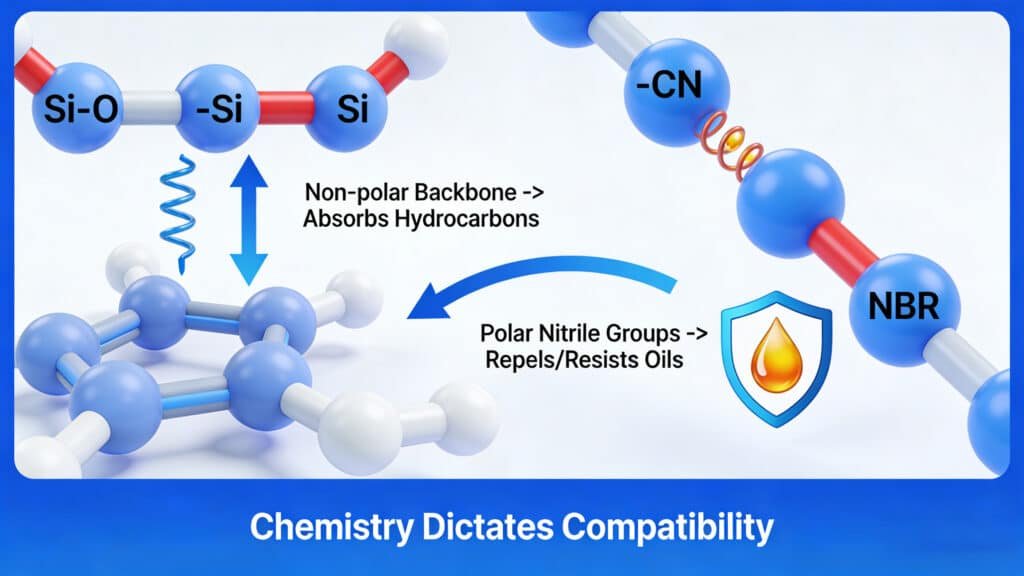
The nitrile butadiene rubber (NBR) is among the most suitable rubbers that resist oil resistance owing to its acrylonitrile attributes that have made it to be polar and more compatible with hydrocarbons.
NBR is an acrylonitrile (butadiene) copolymer, with the acrylonitrile content (usually 30 50) increasing swell resistance, dimensional stability, resistance to petroleum oils, fuels and greases. This contributes to NBR as the preferred provider of automotive engine seals, hydraulic systems and fuel handling components.
Formulation performance: As the acrylonitrile increases, oil resistance increases, but the low temperature performance shrinks slightly.
| Property | NBR |
| Base Chemistry | Nitrile-based rubber |
| Temperature Range | -40°C to 120°C |
| Oil Resistance | Excellent |
| Fuel Resistance | Good |
| Compression Set | Good |
| Cost | Moderate |
The chemistry of NBR is such that it is naturally adapted to petroleum exposure to provide reliable sealing without unreasonable degradation.
Silicone vs NBR: Oil Resistance Comparison
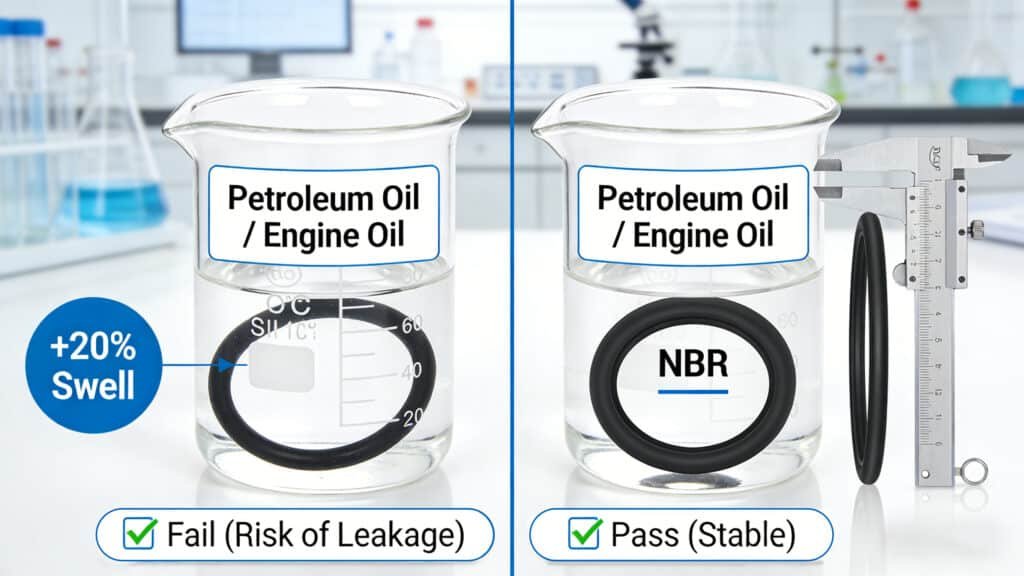
NBR is better stable in petroleum-based oils in direct head-to-head comparison, and silicone is prone to swelling and degradation of the property.
Diffusion of oil molecules into polymer network causes swelling which leads to a rise in volume and can result in phenomena like a loss of seal force. NBR restricts this by polar mechanisms, but silicone non-polar backbone is more permeable to hydrocarbons.
| Oil Exposure Type | Silicone | NBR |
| Engine Oil | Moderate swelling | Excellent |
| Hydraulic Oil | Moderate | Excellent |
| Fuel Exposure | Limited resistance | Good |
| Grease | Acceptable | Excellent |
| Long-Term Immersion | Risk of swelling | Stable |
It is necessary to test oil compatibility (according to ASTM D471 or other immersion standards since the actual additives and temperature may change the results).
Temperature Performance: Where Silicone Gains Advantage
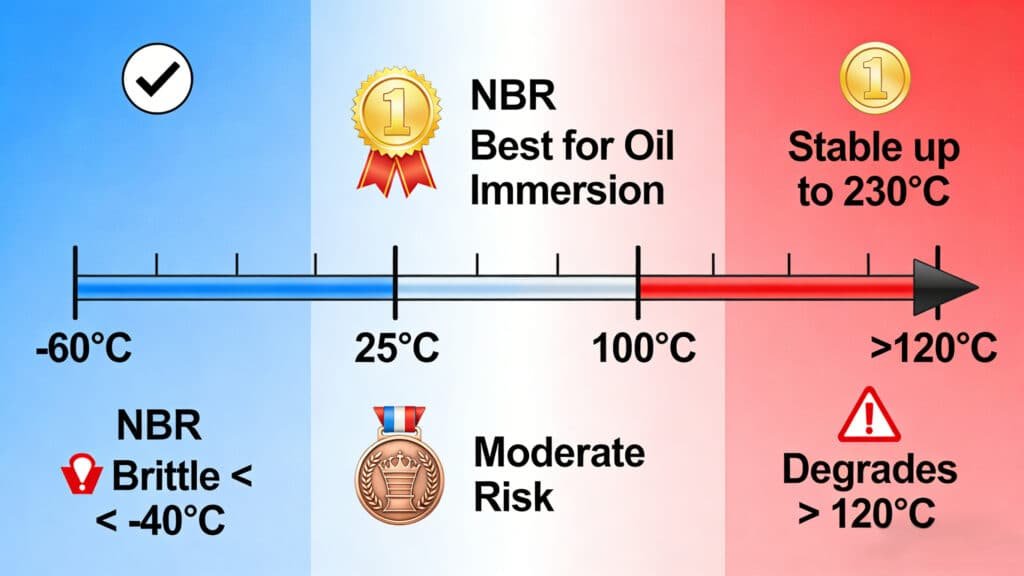
Silicone performs better in extreme temperatures, specially at temperatures exceeding 120 0 C or when subjected to thermal cycling where the temperature has to be above 120 0 C.
Silicone has a broad range and consistent heat aging which is preferred in high engine bay temperatures, turbocharger areas, or when the engine needs to be started cold. NBR has the capability to solidify or lose its flexibility in the presence of high temperature over an extended time, whereas silicone does not.
| Temperature Factor | Silicone | NBR |
| Max Continuous Temp | 200°C+ | 120°C |
| Low Temp Flexibility | Excellent | Good |
| Thermal Stability | Excellent | Moderate |
| Heat Aging | Very stable | Can harden |
The trade-off is obvious: where heat prevails and contacts with oil should be as minimal as possible use silicone; where there should be balanced requirements of oil and moderate temperatures use NBR.
Compression Set and Long-Term Sealing Reliability
Compression set is the measure of permanent deformation at the end of a compression; it is an aggregate of the effects of oil and heat and is used to identify the behavior of seals over long periods.
NBR does not set easily even after prolonged periods of being immersed in oil. Silicone has outstanding performance under dry conditions but can exhibit enhanced set in presence of oil which can cause swellings.
| Factor | Silicone | NBR |
| High Temp Compression | Stable | May harden |
| Oil Immersion Compression | Moderate | Stable |
| Long-Term Static Seal | Good | Very good |
In a constant load of a static seal NBR can be very reliable in an oily environment. Dynamic applications introduce abrasion factors, of which the toughness of NBR is beneficial.
Best Applications: When to Choose Silicone vs NBR
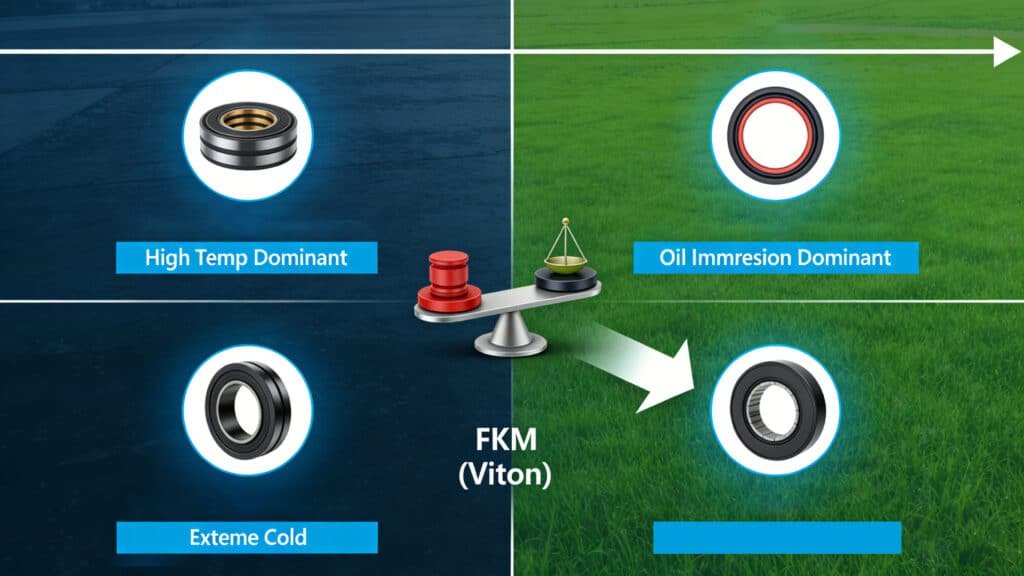
The material will depend on the application: situations that would be dominated by oil would prefer NBR, whereas heat or exposure to the environment would favor silicone.
| Application | Recommended Material | Reason |
| Engine oil seal | NBR | Superior oil resistance |
| Hydraulic system gasket | NBR | Petroleum stability, cost-effective |
| High-temp exhaust seal | Silicone | Heat resistance |
| Outdoor equipment seal | Silicone or NBR | Depends on oil exposure vs weathering |
| Fuel system seal | NBR | Fuel compatibility |
| Electronics enclosure near heat | Silicone | Heat stability, flexibility |
This is generally the case with engine seals and hydraulic gaskets, where NBR is needed due to familiar with NBR oil performance and low swell rates. Silicone is used in situations where silicone, as an engine seal material, or NBR, is leaning towards thermal requirements versus fixed petroleum contact.
Cost and Lifecycle Considerations
NBR is also typically priced with a better total lifecycle in oily applications because it has a lower cost of raw material and it is lower in replacement rate.
Silicone is priced higher but early failures due to swelling under the influence of oil may push up costs of downtimes in an NBR friendly configuration. Longevity of performance is better than the initial price- engineers must consider the mean time between failure and service periods.
Common Mistakes When Choosing Seal Materials for Oil Environments
Experienced teams also tend to fall into the pitfalls that result in seal failures:
- Neglect of oil type (e.g. all “oils” behave the same way or do they?).
- Ignoring temperature surges in operation.
- Choosing without regard to chemistry based on hardness.
- Omission of compatibility testing or immersion tests.
- Failing to consider the dynamic movement or cycles of pressure.
Conclusion — Oil Exposure Demands the Right Chemistry
Attainment of oil resistance finally reduces to the chemistry of elastomers: the polar structure of NBR has great compatibility with petroleum based fluids, so it is the material of choice in most automotive and industrial sealing where the hydrocarbons dominate. Silicone, though excellent in both extremes of temperature and environmental stability, is typically limited in long-term petroleum exposure capacity by the risk of swelling.
Practically, NBR provides high-performance in oil-contaminated areas such as engine rooms and hydraulic systems at a cost-effective price. This can be enhanced however in the cases where high temperatures, thermal cycling, or restricted oil contact are of the main concern and thus silicone could prove to be the better longevity. The right oil resistant gasket is a result of balancing the chemistry of oil, operating temperature, compression and other application requirements that is always tested and not guessed.
(Word count: ~1250)